Join us at GITEX 2025! Discover our solutions at Hall 4, Booth H-30 Book your live demo today.
Categories
E-commerce

Bambuser Alternative for Growing Brands: Why MyLiveCart Wins on Price

Bambuser is one of the most recognised names in live shopping trusted by H&M, L’Oréal, and Mango. It has grown from an enterprise-only platform into one that now offers published self-serve plans for smaller teams.

But Bambuser’s pricing model still requires an annual billing commitment on every paid tier meaning you pay for a full year upfront before you know whether the channel will perform. Its free plan caps out at 250 views per month, and WooCommerce support relies on custom webhooks rather than a native plugin.

If you are a growing ecommerce brand that wants month-to-month flexibility, a more generous free tier to test with, or a native WooCommerce integration this guide compares Bambuser and MyLiveCart directly so you can make the right decision for where your brand is today.

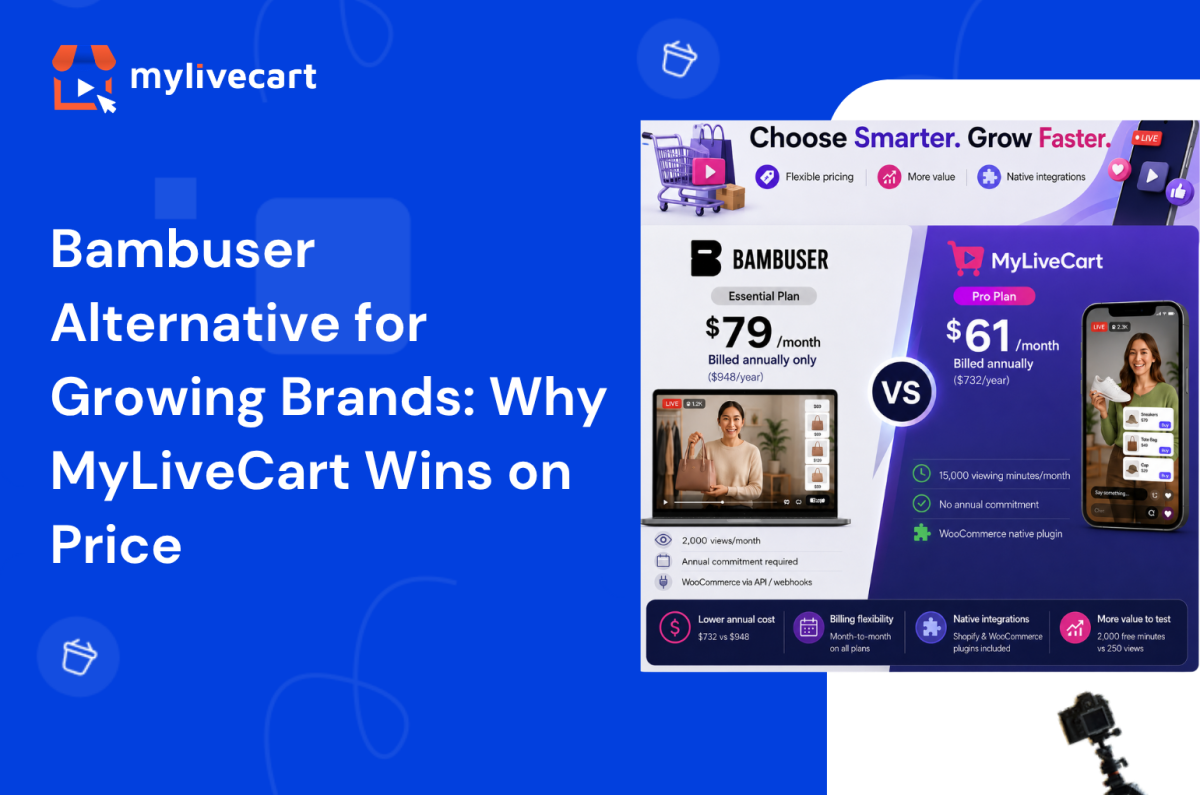
Quick Answer: The strongest Bambuser alternative for growing brands is MyLiveCart. At the same $79/month entry price, MyLiveCart Pro is month-to-month no annual billing required. MyLiveCart’s annual plan is cheaper ($61/month vs Bambuser’s $79/month annual-only Essential tier), and the free plan includes 2,000 viewing minutes per month against Bambuser’s 250 views. Both platforms support Shopify. For WooCommerce, MyLiveCart offers a native plugin; Bambuser relies on custom API integration.

What Is Bambuser?

Bambuser is a Swedish live video commerce platform founded in 2007. It offers two core products: One-to-Many (live shopping broadcast to an audience) and One-to-One (private video shopping with a sales associate).

Originally built for enterprise retailers, Bambuser has expanded its offering to include three published self-serve tiers alongside its Enterprise plan. It powers live shopping for some of the world’s largest retail brands and offers white-label customisation, advanced analytics, and professional services.

Bambuser’s current plans:

  • Free — $0, 250 views/month, 2 users, AI chat support
  • Essential — $79/month, billed annually ($948/year), 2,000 views/month, 3 users, guided onboarding
  • Pro — $249/month, billed annually ($2,988/year), 10+ users, white-labeled player, Mobile SDK, SSO
  • Enterprise — Custom pricing, custom usage, dedicated customer manager

One important detail across the paid tiers: Bambuser Essential and Pro are available on annual billing only. There is no published monthly billing option for either plan.

Why Growing Brands Look for a Bambuser Alternative

The brands most likely to find Bambuser’s model a poor fit are typically at a specific growth stage:

  • Annual revenue: $500K–$20M
  • Team size: 5–50 people
  • Ecommerce platform: Shopify or WooCommerce
  • Live commerce maturity: Testing the channel, running first events, validating product-format fit
Try MyLiveCart Free — No Annual Commitment, No Contract →

At this stage, live shopping software for small and mid-sized businesses needs to be flexible. Committing to an annual plan before you have conversion data from your first event is a real risk. If the channel underperforms or if your strategy changes you are locked in for the year.

You also likely need native WooCommerce support without custom developer work.

MyLiveCart vs Bambuser: Feature Comparison

Feature Bambuser MyLiveCart
Free plan Yes — 250 views/month Yes — 2,000 viewing minutes/month
Entry paid plan $79/month Essential (annual billing only) $79/month Pro (month-to-month)
Annual plan price $79/month (only billing option for Essential) $61/month when billed annually
Annual spend at entry paid $948/year (Essential) $732/year (Pro annual) · $948/year (Pro monthly)
Billing flexibility Annual commitment required on paid plans Month-to-month available on all plans
Self-serve signup Yes — available via app store Yes — direct signup
Shopify integration Yes — Shopify App Store Yes — native plugin, all plans incl. free
WooCommerce integration Via custom webhooks / API Yes — native plugin, all plans incl. free
In-stream checkout Yes Yes
Product tagging during live Yes Yes
Live chat Yes Yes
Event analytics Yes Yes — event + product-level
Event replay / VOD Yes Yes (Pro plan and above)
One-to-one video shopping Yes Roadmap
White-label / custom branding Pro plan only Business plan ($259/month)
Co-host support Yes Yes
Overage rate $0.25 per view $12–15 per 1,000 viewing minutes
Cancel anytime Limited by annual billing Yes — month-to-month plans available
Developer required For WooCommerce integration No — no-code plugin for Shopify + WooCommerce

Looking for a Bambuser alternative for Shopify specifically? Both platforms support Shopify. The key differences are billing flexibility and the WooCommerce question see the full feature breakdown for a detailed comparison.

MyLiveCart vs Bambuser: Pricing Comparison

Both platforms now publish their pricing. Here is how they compare at each tier.

Free Plans

Bambuser Free MyLiveCart Starter
Price $0 $0
Viewing capacity 250 views/month 2,000 viewing minutes/month
Live events Included Unlimited
Shopify integration Yes Yes
WooCommerce integration Via API Yes — native plugin
Streaming duration Not specified Up to 1 hour
Branding Not specified MyLiveCart watermark

Note on metrics: Bambuser counts “views” (unique viewers) while MyLiveCart counts “viewing minutes” (viewers × duration). These are different measurements and not directly comparable. For a 30-minute live event, 250 Bambuser views = 250 unique viewers; 2,000 MyLiveCart viewing minutes = approximately 65–70 viewers at average session length. For shorter shoppable video content, Bambuser’s free plan may support more interactions per month.

Entry Paid Plans

Bambuser Essential MyLiveCart Pro
Price $79/month $79/month (or $61/month annually)
Billing Annual only ($948/year) Month-to-month or annual
Annual spend $948 $732 (annual) · $948 (monthly)
Viewing capacity 2,000 views/month 15,000 viewing minutes/month
Users 3 Unlimited
Event replay Included Yes
Simulcasting Not specified Yes
WooCommerce Via API Native plugin
Overage $0.25/view $12/1,000 minutes

At the same $79/month price point, Bambuser Essential requires a $948 annual commitment upfront. MyLiveCart Pro is available month-to-month — you pay $79 in month one and can cancel before month two if results do not support continuing.

If you are willing to commit annually, MyLiveCart Pro at $61/month saves $216/year compared to Bambuser Essential at $79/month (annual billing).

See the complete MyLiveCart pricing page for current plan details and active offers.

Start on the free plan. Upgrade month-to-month when you’re ready. No year-long commitment.

Start Your Free MyLiveCart Account →

Where MyLiveCart Works Better for Growing Brands

1. No Annual Commitment Required

Bambuser’s Essential and Pro plans are available on annual billing only. You pay for the full year before running a single paid event.

MyLiveCart Pro is available month-to-month. If your first three events do not generate the ROI to justify the subscription, you cancel before the next billing cycle. There is no contract, no minimum term, and no cancellation fee.

2. Cheaper Annual Plan

If you do want to commit annually, MyLiveCart Pro at $61/month ($732/year) is less expensive than Bambuser Essential at $79/month ($948/year) while offering 15,000 viewing minutes per month against Bambuser’s 2,000 views per month (noting these are different metrics).

3. Native WooCommerce Integration

MyLiveCart has a native WooCommerce plugin available on all plans including free. It connects your product catalog, embeds the live stream widget, and routes in-stream purchases through your existing WooCommerce checkout no developer needed.

Bambuser supports WooCommerce via custom API and webhooks. This works, but it requires developer involvement to implement and maintain. For teams without in-house technical resource, this is a meaningful barrier. See the WooCommerce integration guide for how MyLiveCart’s setup works.

4. More Generous Free Plan for Testing

MyLiveCart’s free Starter plan gives you 2,000 viewing minutes per month with unlimited live events, product tagging, in-stream checkout, and live chat enough to run multiple events and build initial performance data before spending anything.

Bambuser’s free plan provides 250 views per month with access to the product suite, which is suited for very limited-scale testing.

5. Shopify Integration Included at Every Tier

MyLiveCart’s native Shopify plugin is included on every plan including free. Connect your product catalog in under 10 minutes. No developer required, no code changes to your store.

Bambuser also has a Shopify app available for all tiers. This is a comparable advantage for both platforms.

At a Glance: Which Platform Is Right for You?

Choose Bambuser if you are comfortable committing to annual billing, your primary store is Shopify (not WooCommerce), you need one-to-one video shopping capability, or you are moving toward the Pro/Enterprise tier for white-label deployment.

Choose MyLiveCart if you want month-to-month billing flexibility, you run a WooCommerce store and need a native plugin, you want the lower annual plan price, or you are still in the early stages of building your live commerce channel.

When Bambuser Might Still Be the Right Choice

Bambuser is the better fit in specific circumstances:

  • You are comfortable with annual billing and your live commerce strategy is confirmed — the Essential plan at $948/year is a reasonable investment for an active programme
  • One-to-one video shopping is a core channel requirement — personalised video consultations at scale, integrated into CRM and service workflows (MyLiveCart has this on roadmap)
  • You need white-label deployment — Bambuser’s Pro plan includes a fully white-labeled player; MyLiveCart offers custom branding on the Business plan
  • Your store is on Shopify — both platforms offer strong Shopify support, so this is less of a differentiator
  • You are scaling toward enterprise — Bambuser’s Pro and Enterprise tiers offer Mobile SDK, SSO, and dedicated customer management for larger operations.

Frequently Asked Questions About Bambuser Alternatives

What is the best Bambuser alternative for small and mid-sized brands?

MyLiveCart is a strong Bambuser alternative for growing brands that want professional live shopping features without an annual billing commitment. It offers a free plan, native Shopify and WooCommerce integration, in-stream checkout, product tagging, live chat, and event analytics with month-to-month billing available on all paid plans.

Is MyLiveCart cheaper than Bambuser?

It depends on how you compare. At the $79/month entry paid tier, Bambuser Essential requires annual billing ($948/year) while MyLiveCart Pro is available month-to-month at $79 or annually at $61/month ($732/year). On annual plans, MyLiveCart is $216/year cheaper. Month-to-month, the entry price is the same — but only MyLiveCart offers that flexibility without a year-long commitment.

Does MyLiveCart integrate with Shopify like Bambuser does?

Yes. MyLiveCart has a native Shopify plugin on all plans including free. It connects your product catalog automatically, embeds the live stream on your storefront, and routes purchases through your existing Shopify checkout. No developer or code changes required. Bambuser also has a Shopify app both platforms support Shopify well.

Does MyLiveCart support WooCommerce?

Yes with a native plugin on all plans including free. This is one of the clearest differences between the two platforms. Bambuser supports WooCommerce via custom webhooks and API, which typically requires developer involvement. MyLiveCart’s WooCommerce plugin connects your store without any custom development.

Can I switch from Bambuser to MyLiveCart?

Yes. If you are currently on a Bambuser plan and your annual term is ending, MyLiveCart is a direct alternative for the core live shopping feature set. Your Shopify or WooCommerce store connects in minutes. Because MyLiveCart offers month-to-month billing, you can also run a parallel event on MyLiveCart to compare performance before fully committing to a switch.

Does MyLiveCart require an annual contract?

No. MyLiveCart plans are available month-to-month. You can upgrade, downgrade, or cancel at any time no minimum term, no cancellation fees. An annual plan is available at a discounted rate if you choose to commit.

What features do both MyLiveCart and Bambuser share?

Both platforms offer: live video broadcast, in-stream product tagging, buy buttons for in-stream purchase, live chat, event analytics, event replay, co-host support, and Shopify integration. The core live shopping feature set is comparable. The primary differences are billing structure (annual-only vs month-to-month available), WooCommerce integration approach, and pricing on annual plans.

Switch to an Affordable Live Commerce Platform That Grows With You

Bambuser is a capable platform and, with published self-serve pricing, now accessible to brands beyond the enterprise tier. The question is not whether Bambuser works it is whether annual billing, API-dependent WooCommerce integration, and the higher annual cost are the right trade-offs for where your business is today.

If you want to start free, validate the channel without a year-long commitment, and run on your WooCommerce or Shopify store with no developer required MyLiveCart is worth serious consideration.

  1. Create your free MyLiveCart account
  2. Connect your Shopify or WooCommerce store in minutes
  3. Run your first live shopping event — at no cost, no annual commitment

Want to see the platform before signing up? Book a free live demo and we will walk through the features, the integrations, and the right plan for your business.

Get a Free Live Demo →
Categories
E-commerce Live Shopping

Live Streaming for Ecommerce: The Complete Guide for Online Stores in 2026

Live streaming for ecommerce is no longer a trend brands are watching from the sidelines. It is the fastest-growing sales channel in online retail and in 2026, every major ecommerce category from fashion to food to consumer electronics is running live shopping events directly on their stores.

The reason is simple: live video converts at rates static product pages cannot match. A shopper who watches a host demonstrate a product, ask questions in real time, and see other viewers buying alongside them is a fundamentally different kind of buyer than one scrolling a product grid alone.

This guide covers everything you need to know how live streaming ecommerce works, what formats drive the most sales, how to choose the right platform, and how to go live on your store today.

Quick Answer: Live streaming for ecommerce is the practice of broadcasting real-time video on your online store while selling products in-stream viewers watch, ask questions, and add to cart without leaving the stream. Brands running live commerce events report 30–45% increases in sales, 60% improvements in customer retention, and conversion rates 3–9x higher than standard product pages. To get started, you need a live streaming platform like MyLiveCart that integrates with your store (Shopify or WooCommerce) and handles the video, chat, and checkout layers for you.

What Is Live Streaming for Ecommerce?

Live streaming for ecommerce also called live commerce, live selling, or livestream shopping is the practice of broadcasting real-time video on your online store while selling products directly through that broadcast. Hosts demonstrate products, answer viewer questions live, and trigger buy buttons on-screen that let viewers add to cart and complete checkout without pausing the video or navigating away.

Unlike traditional video commerce (pre-recorded product videos on a product page), live streaming ecommerce is interactive. The host responds to the audience in real time. Viewers see other people buying. Limited-time offers create genuine urgency. The result is a purchasing environment that more closely resembles a physical retail experience than anything else available in online commerce.

Live commerce originated in China, where it now accounts for over 20% of all ecommerce transactions. Western markets have followed rapidly: live shopping platforms saw triple-digit growth between 2022 and 2025, and the global live commerce market is projected to exceed $500 billion by 2027.

How Live Streaming Ecommerce Works

A live streaming ecommerce event has three layers working simultaneously:

1. The video layer Your host streams live video from a camera smartphone, laptop webcam, or professional setup. The stream is encoded and delivered to viewers via a CDN (Content Delivery Network) with under 5 seconds of latency, so the experience feels genuinely live rather than delayed.

2. The commerce layer Products from your store catalog are loaded into the event in advance. During the stream, the host highlights individual products triggering a product card and buy button to appear on screen. Viewers click “Add to Cart” without leaving the video. Checkout uses your store’s existing payment flow.

3. The interaction layer A live chat panel runs alongside the video. Viewers ask questions, the host responds by name, and other viewers see the exchange. Emoji reactions, viewer counts, and time-limited offer banners create social proof and urgency in real time.

On the backend, every viewer action watch time, product clicks, add-to-cart events, purchases is tracked at the event level, giving you conversion data per product highlighted, not just per page view.

Why Live Streaming for Ecommerce Drives Higher Sales

The performance gap between live streaming ecommerce and static product pages is not marginal it is structural. Live video removes the three biggest objections in online shopping: uncertainty about the product, inability to ask questions, and lack of urgency.

Brands using MyLiveCart’s live shopping platform have reported:

  • 45% increase in sales within the first month of going live
  • 98 products sold in 23 days from a single jewellery brand’s live campaign
  • 3x increase in product inquiries and purchase intent
  • 60% improvement in customer retention
  • 2x improvement in engagement rate compared to static product pages

These results hold across categories fashion, jewellery, skincare, consumer electronics, food and beverage because the underlying mechanism (real-time demonstration + immediate purchase) is category-agnostic.

The conversion advantage comes from four specific dynamics:

Trust built through demonstration: Viewers see the product in motion how fabric falls, how a serum absorbs, how a gadget fits in a hand. This removes the ambiguity that causes hesitation on a product page.

Real-time objection handling: When a viewer asks “does this come in XL?” and gets an immediate answer, that objection is resolved in seconds rather than left to fester until the shopper abandons the cart.

Social proof at scale: Visible viewer counts, live chat activity, and emoji reactions signal that other real people are watching and buying which reduces the perceived risk of purchase.

Scarcity and urgency: “Only 8 left in stock” or “free shipping for the next 10 orders” means something when said live, in real time, rather than displayed as a static label that shoppers have learned to ignore.

Types of Live Streaming Formats for Ecommerce

Not every live stream follows the same format. The right format depends on your product category, audience size, and sales goal.

Product Launch Streams

Reveal a new product live, with an exclusive first-look for viewers. Works especially well for limited editions, seasonal collections, and subscription drops. Creates urgency because the first-mover advantage is real viewers who buy during the launch get it before anyone else.

See How MyLiveCart Powers Live Streaming Ecommerce — Get a Free Demo →

Tutorial and How-To Demos

Show the product being used step by step. Highly effective for skincare, cooking, tools, and anything that requires instruction. The demonstration closes the “but will it work for me?” objection that stops purchases on static pages.

Q&A and Expert Sessions

Host a live interview or panel where a product expert a dermatologist, a chef, a stylist demonstrates and answers audience questions in real time. Builds brand authority while educating viewers about the product.

Flash Sales and Limited-Time Drops

Time-limited offers available exclusively during the live event. Viewer gets a benefit (early access, discount, free shipping) that expires when the stream ends. Creates genuine urgency that static sale banners cannot replicate.

Behind-the-Scenes and Factory Tours

Show how the product is made, where it comes from, or how your brand operates. Particularly effective for brands where provenance and craft matter artisan goods, sustainable fashion, specialty food.

Influencer and Brand Ambassador Collabs

Invite an influencer or ambassador as a co-host. They bring their audience to your stream; you provide the product and purchase infrastructure. Extends your reach without requiring a large existing audience of your own.

How to Choose a Live Streaming Platform for Your Ecommerce Store

The live streaming platform you choose determines what your viewers can do and what data you can act on. Evaluate platforms on these five criteria before committing:

1. Integration with Your Ecommerce Platform

Your live streaming platform must connect directly to your product catalog Shopify, WooCommerce, or a custom backend. Without this, you are manually entering product details before every event, and inventory does not update in real time. MyLiveCart’s full feature set includes native integration for both major platforms.

2. In-Stream Checkout (Checkout Without Leaving the Video)

If a viewer has to navigate to a separate product page to buy, you lose a significant portion of them in transit. The buy button must surface within the stream player and add directly to your store’s cart. This is the most commonly missed requirement in platform evaluation.

3. Event-Level Analytics

You need to know which products converted, not just how many people watched. Platform-level analytics (“1,200 viewers”) are useless for product strategy. Event-level analytics (product A: 47 add-to-carts, product B: 12 add-to-carts, average watch time 14 minutes) tell you how to structure your next event.

4. Replay and VOD

Your live event continues working after it ends if it is available as a replay on your store. Every viewer who missed the live event is a potential buyer of the on-demand version. Platforms that do not record automatically leave that revenue on the table.

5. Pricing That Scales With You

Look for a platform that has a free or low-cost entry point so you can test and learn before committing significant budget. MyLiveCart’s free Starter plan includes unlimited events and 2,000 viewing minutes per month enough to run your first several events and validate the format for your audience before upgrading.

How to Get Started with Live Streaming for Your Ecommerce Store

Getting your first live shopping event live takes less than a day most of it is planning, not setup. Here is the process from zero to live:

Step 1 — Choose Your Platform and Sign Up

Create a free MyLiveCart account at web.mylivecart.com/sign-up. The free Starter plan includes unlimited events, unlimited products per event, and the integration plugin for your store. No credit card required.

Step 2 — Connect Your Store

From your MyLiveCart dashboard, go to Integrations and connect your store. The Shopify integration takes under 60 seconds authorize the app, and your entire product catalog syncs automatically. WooCommerce follows the same process.

Step 3 — Plan Your Event Format and Product Selection

Decide which format fits your goal (launch, demo, flash sale). Select 8–15 products to feature enough to fill a 30–60 minute stream without rushing. Order your products: open with your strongest sellers to build early momentum, then introduce newer or higher-consideration items mid-stream when trust is established.

Step 4 — Promote the Event in Advance

Share your event link 48–72 hours ahead via email, social media, and your store’s homepage. MyLiveCart generates a pre-event page that viewers can bookmark and share. Brands that promote in advance consistently see 2–3x more viewers than unannounced streams.

Step 5 — Go Live

At event time, click Start Event from your dashboard. Your stream embeds on your store automatically. During the event, click products in your event panel to highlight them the buy button appears on screen for all viewers in real time. Respond to chat questions by name. Add urgency with limited-time offers.

Step 6 — Review Your Analytics

After every event, your analytics dashboard shows peak viewers, watch time, products highlighted, add-to-cart rate, conversion rate per product, and total orders. Use this data to decide which products to lead with next time, which offer types drove the most action, and which time slot brought the largest audience.

Ready to run your first event? Your store can be live this week.

Start Live Streaming Free — No Developer Needed →

Live Streaming Ecommerce Best Practices

Keep Events Between 30 and 60 Minutes

Under 30 minutes does not give late arrivals enough time to engage and buy. Over 60 minutes sees significant audience drop-off after the halfway point. The 30–60 minute window consistently produces the highest engagement-to-conversion ratio.

Start Selling Within the First 5 Minutes

Viewers decide within the first 3–5 minutes whether to stay. Lead with a strong product, a compelling offer, or a bold claim then back it up. Audiences who stay past 5 minutes convert at significantly higher rates than those who leave early.

Feature 8–12 Products Per Hour

Fewer than 8 products leaves too much time on each item and loses momentum. More than 15 per hour rushes viewers and reduces their confidence in each purchase decision. Spending 4–6 minutes per product is the optimal pacing for most categories.

Use Your Chat as a Sales Tool

Every question in chat is a sales signal. When a viewer asks “does this ship internationally?” or “what size should I get?” they are close to buying. Prioritise those questions over generic comments. Resolve objections publicly so every viewer watching benefits.

Go Live Consistently, Not Just Once

The brands that see compounding results from live streaming ecommerce go live on a regular schedule weekly or bi-weekly. Audiences learn when to expect you. Returning viewers convert at higher rates than first-time viewers because trust is already established.

Live Streaming on Your Own Store vs. Social Platforms

The most common question from brands starting live commerce is whether to stream on Instagram, TikTok, or YouTube — or on their own store. The answer depends on where you are in your brand journey.

Factor Instagram / TikTok / YouTube Live Live Streaming on Your Store
Audience reach Large, built-in audience Your existing audience + promotion
Checkout location Third-party platform Your own store
Customer data Platform owns it You own it
Product catalog sync Limited or manual Full, automatic
Analytics Views and likes Product-level conversion data
Replay on your store No Yes
Brand control Platform-branded UI Fully your brand

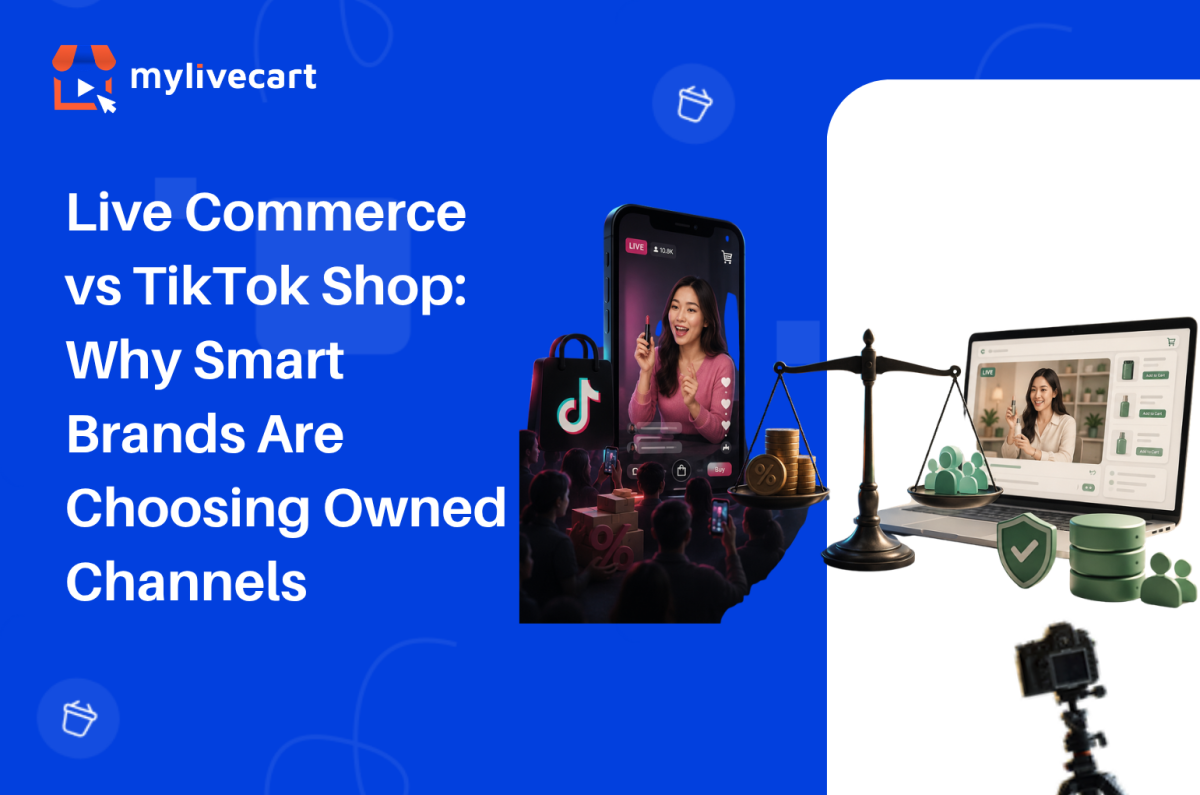
The strategic answer: social platforms are useful for discovery and audience building. Your own store is where sales and data ownership live. The highest-performing brands use both they promote on social, then send viewers to their store for the actual purchase event.

Frequently Asked Questions About Live Streaming for Ecommerce

What is live streaming for ecommerce?

Live streaming for ecommerce is the practice of broadcasting real-time video on an online store while selling products through the stream. Viewers watch a host demonstrate products, ask questions in a live chat, and add items to cart without leaving the video all on the retailer’s own website.

How does live streaming increase ecommerce sales?

Live streaming increases ecommerce sales by removing the three main objections that stop online shoppers: uncertainty about the product (resolved by live demonstration), inability to ask questions (resolved by real-time chat), and lack of urgency (created by limited-time in-stream offers and visible social proof).

What equipment do I need to start live streaming for ecommerce?

You need a device with a camera (smartphone or laptop works), a stable internet connection, and a live streaming platform connected to your store. No professional studio equipment is required to start brands run successful live events from phones and basic ring lights.

Which ecommerce platforms support live streaming?

Shopify and WooCommerce both support live streaming through MyLiveCart’s native plugins. The live stream embeds directly on your store across all platforms.

How long should a live shopping event be?

Most successful live shopping events run between 30 and 60 minutes. This is long enough for late joiners to engage and buy, but short enough to maintain audience attention and host energy throughout. Events under 20 minutes tend to underperform because they do not allow time for the audience to warm up and trust the host.

How many products should I feature in a live event?

Most successful live shopping events feature 8–12 products in a 30–60 minute stream roughly one product every 4–6 minutes. This pacing gives viewers enough time to consider and buy each item without feeling rushed, while maintaining momentum across the event.

Is live streaming ecommerce only for large brands?

No. Live streaming ecommerce works across brand sizes. The advantages real-time demonstration, live Q&A, urgency apply equally to a small jewellery maker with 500 email subscribers and a large fashion retailer with millions of followers. MyLiveCart’s free plan is specifically designed for brands starting their first live commerce events.

Start Live Streaming for Your Ecommerce Store Today

Live streaming ecommerce is not a future consideration it is the channel your competitors are already testing. The brands that establish a consistent live shopping presence now will have a significant advantage in audience trust, conversion data, and repeat buyer rates by the end of 2026.

Getting started takes three minutes:

  1. Create your free MyLiveCart account
  2. Connect your Shopify or WooCommerce store
  3. Run your first live event this week

If you would like a specialist to walk through your first event setup, book a free live demo and we will plan your first stream together format, product selection, promotion, and analytics review included.

Start Your First Live Shopping Event Today

Categories
Business E-commerce Live Shopping

7 Key Approaches for Expanding Your E-Commerce Business Globally

However, in today’s dynamic society, guarded by technology, such changes as the growth of online businesses and global e-commerce are inevitable. Coming about from virtual technology, e-commerce is a major component of the commercial game. The success of such a market has resulted in numerous people visiting this new land looking for opportunities through which they can achieve considerable success and wealth.

Just as with normal enterprises, many brands and internet businesses have originated in their niche market, trying to cater to the needs and wants of local customers. However, with time, numerous people have come to see that the next step in growth is geared towards expansion of the market worldwide for international clients.

And so, to guide you into this new world of commerce, this article will explore and guide you to several Key approaches for expanding your e-commerce business to the global market. From deciphering market nuances to the pivotal role of social media trends, each approach promises a captivating journey through the avenues that propel businesses to international acclaim. 

7 Key Approaches for Expanding Your E-Commerce Business Globally

Know Your Market

It is important that before venturing beyond your local market, sellers and businesses must have an understanding of the type of environment your business will be venturing. By learning a country’s culture before expanding into a market outside your local market home country, sellers and online businesses can gain new insights that can make the difference between selling to customers and alienating them.

This can be a difficult but rewarding strategy; after all, gaining a good understanding of the local environment and its norms can be a major issue, as shoppers from other countries can quickly be turned off if their local customs aren’t respected. A major example of such is Black Friday, which would be a foreign concept in France, just as much as Singles Day would be a foreign concept to North Americans.

As such, sellers and businesses can do this by localizing their businesses’ sales, fulfillment, and distribution efforts as much as possible so that potential customers feel comfortable buying from them.

Overall, sellers and other online businesses must localize their online offers for every international market they enter if they want to compete against local retailers and retailers.

Know Why You’re Going Global

Before going through plans and steps to transform your online business from local to global, it is vital to establish the reasons and goals of your venture. At the same time, you must have knowledge concerning whether your products would sell in the larger market.

After all, in order for many businesses to grow, businesses must expand beyond their local reach and into the global market, but it is vital to acknowledge to never assume even if you have been successful in your own local market, you can succeed in the global market.

As such, it is vital to ask whether your product is unique or different enough that there is going to be a lot of demand. To do so, Test new markets to determine whether they are ready for your products, if your price-point resonates, and if you can meet buyers’ wants or needs for overall customer experiences.

Though it can be time-consuming, doing your homework before expanding will pay off in the end. After all, if you get it right, your business can grow and perhaps start a new trend; if not, then this new venture can damage your own business at a fast pace.

Insure Your Own Logistics

When your online business expands into the global market, you expose your products and business to a larger amount of potential customers; with these increases, there is also an increase in demand, necessitating an increase in supply. To keep up with this increase, it is vital to assess whether your logistic nature is capable of handling such a potential increase in demand. After all, it’s important to know how you’ll deliver products to customers once you have them in a new market.

As a result, refrain from waiting until you have got the first sale to decide the things you’re doing afterward; everything must be planned from the beginning. After all, Lukomskyj claims that many firms encounter several problems, particularly when it comes to marketing, selling, fulfilling, and supporting clients outside of the nations where they are accustomed to conducting business.

As a result, many sellers and companies must first decide whether or not to sell in the nation they are currently operating and then transport to the customer or to establish operations in target countries with a fully localized experience accepting local payments in the local currency and subject to applicable tax demands.

Watch For Social Media Trends

Social networking may help firms improve their online presence. It is also important for the success of e-commerce enterprises. The study suggests that approximately. By 2020, 2.5 million people will have used one or more social media channels to achieve e-commerce success.

The reason for this is that businesses increasingly recognize the crucial role of social media platforms for e-commerce success. Social media’s popularity continues to rise. Approx. 80% of internet marketing is already underway, with Facebook accounting for 85% of transactions made through social networking sites.

Customer spans are becoming increasingly short, and online businesses must ensure that they attract people people’s immediately.

Multiple Payment Options

With most online businesses, the use of multiple payment options is highly crucial to success. As such, it is vital to acknowledge that when expanding towards a larger market, your business must also acknowledge that online payments may vary from locally to globally. After all, some countries prefer to use credit cards for online payments, while others prefer digital payment systems like PayPal.

Currently, consumers may make purchases all day long using a variety of payment methods, including debit cards, Apple Pay, conventional credit, and rapidly expanding transfer services like Zelle and Venmo.

Translate To The Local Language

With your online business expanding to foreign countries and foreign customers, it is vital to localize their views by implementing a translation feature. This is essentially important as most online businesses opt out of doing so. After all, a large portion of the world speaks and understands English.

But this notion can be very damaging after all by knowing the local market and competition, many have discovered, especially in Europe where 9 out of 10 Europeans say they always prefer to shop on sites in their own language when given a choice, so translated content is a must if local language competitors are serving up products that directly compete with yours.

At the same time, it is simple to adopt an automatic translation, but this can also affect your customer relations and conversion rate, which may be caused by translation errors. As such, it is highly suggested that online businesses and sellers consult a native speaking professional to review your business.

The Use Of An Effective Platform

One of the most basic practices is to choose the correct platform with the right features and services. A major example of such a platform is Mylivecart, a live-streaming solution that transforms the seller’s company into a fascinating virtual theatre for customers all over the world. By merging traditional e-commerce with cutting-edge live-streaming technology, Mylivecart makes a revolutionary contribution and gives customers an enjoyable and interactive shopping experience.

In order to understand Mylivecart, all you need to do is picture a seller having two or three minutes to go live and create a virtual world that is engaging enough to help them sell products and form real connections with other merchants. A tool is more than just Mylivecart; it connects to the sellers and consumers, fostering genuine connections that result in unexpected sales increases.

Mylivecart Pricing and Features

The pricing plans of Mylivecart are flexible and adaptable in nature, as they cater to the needs of diverse businesses. In this regard, all pricing plans are devised to improve the live shopping experience for different levels of event hosting and audience engagement.

  • Basic Plan ($49/month)
      1. 30 Event Hours: Ideal for start-ups launching new collections with live-stream sessions that are gripping.
      2. 1 Host, 200 Attendees: Intimate interaction with a small crowd, leading to active involvement at the moment.
      3. 7-Day Analytics: Get valuable insights for a week, optimizing approaches based on recent achievements.
      4. 2 Social Channels: Share live events via two channels to maximize coverage.
      5. App Integrations: Seamless integration with Shopify, WordPress, and preview support for Magento, Salesforce, and Odoo.
  • Growth Plan ($179/month)
      1. 50 Event Hours: Ideal for growing enterprises conducting regular live events featuring product launches.
      2. 2 Hosts, 500 Attendees: Double hosting capacity for a larger audience and enhanced interactivity.
      3. 30-Day Analytics: Extended analytics access for a month, providing a deeper understanding of trends.
      4. 5 Social Channels: Expand social reach by broadcasting across five platforms.
      5. App Integrations: Same robust integrations as the Basic Plan.
  • Expansion Plan ($299/month)
      1. 100 Event Hours: Tailored for established brands hosting extensive live interactions.
      2. 4 Hosts, 1000 Attendees: Increased hosting capability for dynamic and engaging live events.
      3. 60 Days Analytics: Two months of analytics retention for strategic planning and performance evaluation.
      4. All Social Channels: Maximize visibility by streaming across all available social media channels.
      5. App Integrations: Complete integration solutions with the most popular e-commerce platforms.
  • Enterprise Plan (Customized)
    1. Tailored solutions that provide a range of integrations for a seamless live shopping experience.
    2. All Social Channels: Broadcast outreach to several social media networks.
    3. App Integrations: Full range of integrations to automate live shopping events.

Conclusion

To conclude, it can be said that the modern commercial market has been changing due to advancements in technology and communication; a major example of such is the rise of online businesses and e-commerce, which has created a new frontier for commerce and a new market with new opportunities to gain money. As many businesses and companies welcome and embrace these changes, many have begun to venture out from their local markets to the global stage.

Based on several testimonies and experiences, we have identified seven ways to expand your E-Commerce Business to the global market. From this journey, we have discussed several strategies, both basic and new. Ranging from knowing who you are selling to considering multiple methods of payment and perhaps even from understanding cultural nuances to navigating social media trends, these approaches give an image of the rhythm of a global marketplace. 

As such, it can be seen that the e-commerce market is not merely a new landscape for selling and transactions but also a vibrant tapestry where businesses transcend boundaries, intertwining with the global narrative. As the digital symphony plays on, businesses find not just customers but lifelong patrons on the grand stage of international commerce.

Categories
Business E-commerce Live Shopping

How Live Streaming API is Transforming E-Commerce with Augmented Reality Try-Ons

In the dynamic realm of business, the symbiotic evolution of technology and the internet has redefined the landscape. This change has birthed online businesses and E-commerce, revolutionizing how transactions unfold. Amid this digital tapestry, live streaming and live streaming APIs have risen as omnipresent conduits of engagement. Augmented Reality (AR) and Virtual Reality (VR) have emerged as avant-garde catalysts, reshaping the online shopping experience. 

And so this article will embark on an exhilarating exploration into the factors of how live streaming APIs and Augmented Reality Try-Ons, and discover how these have changed the E-commerce market towards an immersive, interactive, and visually enchanting venture. 

Welcome to a journey where technology paints the canvas of commerce with innovation and excitement.

Elevating E-Commerce Experiences: Live Streaming API and the Revolution of Augmented Reality Try-Ons

Live Streaming’s Dynamic Impact

Livestreaming APIs are remodeling the e-commerce panorama by infusing dynamic, real-time interactions into the purchasing experience. The creation of Augmented Reality (AR) Try-Ons within live streams is going past the traditional way of how products are presented. 

A good example of such is merchandise brands making use of live streaming to exhibit the functionality and features of their products. 

Customers, from the comfort of their houses, can truly attempt distinct clothing, exploring patterns and suits in actual time. This dynamic technique no longer simply immerses buyers inside the emblem’s services; however, it also mirrors the tactile experience of attempting on garments in a bodily keep, making online style retail extra enticing and personalized.

Seamless Customer Engagement

Live streaming APIs facilitate seamless communication among shops and customers, fostering proper two-manner communication. Augmented Reality (AR) Try-Ons take this engagement to the next degree, creating a virtual trial environment. 

A good example of such are beauty brands making use of live streaming to conduct virtual makeup tutorials. 

Viewers can use AR Try-Ons to test one-of-a-kind cosmetic products in actual time, receiving personalized recommendations from splendor specialists. This seamless interaction no longer only enhances studying enjoyment but also establishes a deeper connection between the emblem and customers, as people actively take part in the product exploration technique, transcending the boundaries of conventional online shopping.

Frictionless Shopping Experiences

Live streaming APIs, coupled with Augmented Reality (AR) Try-Ons, orchestrate seamless and convenient buying reports. Picture a situation in which an internet fixtures shop integrates live streaming to showcase its merchandise. 

Through AR Try-Ons, clients can truly place specific furnishings portions of their dwelling spaces, gauging how each item enhances their home decor. This no longer most effectively streamlines the selection-making technique; however, it also eliminates uncertainties about size, color, and style. 

The combination of real-time inventory updates and AR Try-Ons transforms the digital shopping adventure into an intuitive and simple process, mirroring the convenience of traditional shopping stores.

Immersive and Trust-Building

With the combination of live streaming and Augmented Reality (AR) Try-Ons, customers are exposed to an immersive event that fosters agreement and confidence. Consider a situation where a cosmetic brand makes use of live streaming to showcase makeup products. 

With AR Try-Ons, customers can absolutely practice different cosmetics in actual time, visualizing how every product complements their capabilities. This interactive exploration lets customers make knowledgeable selections, reducing the apprehension associated with online splendor purchases. 

By immersing customers in a lifelike trial of the merchandise, the brand builds credibility and loyalty, transforming the digital purchasing landscape into a straightforward and fun beauty session.

Accelerated Customer Decision Paths

Live streaming, coupled with Augmented Reality (AR) Try-Ons, acts as a catalyst in expediting client choice paths inside the e-commerce realm. Imagine a scenario in which a style retailer utilizes live streaming to show off a new garb line. 

Through AR Try-Ons, visitors can instantly honestly try on one-of-a-kind clothes, expediting their journey from product discovery to selection-making. This streamlined system reduces the time historically spent on considering choices, growing a more efficient and enjoyable shopping experience. 

By bridging the gap between recognition and buying, live streaming with AR Try-Ons transforms indecision into swift and assured consumer action.

Social and Collaborative Commerce

Live streaming APIs, together with the immersive generation of Augmented Reality (AR) Try-Ons, usher in a new era of social and participatory trading. Consider the following scenario: a Splendor brand hosts a live makeup tutorial with AR try-ons, allowing viewers to absolutely follow featured goods. 

This social involvement goes beyond the movie, with viewers sharing their AR-enhanced looks on social media channels, establishing a network of beauty enthusiasts. The participatory aspect of e-commerce turns it into a shared experience in which customers actively participate to the story of a product. 

As a consequence, corporations may use the collective to influence engaged communities through product marketing and symbol advocacy.

The Use of an Effective Platform

One of the most basic practices is to choose the correct platform with the right features and services. A major example of such a platform is Mylivecart, a live-streaming solution that transforms the seller’s online company into a fascinating virtual theatre for customers all over the world. Mylivecart transforms into a ground-breaking contribution by fusing traditional e-commerce with cutting-edge live-streaming technologies, giving customers an enjoyable shopping experience.

The easiest way to understand Mylivecart is to picture a seller having two or three minutes to go live and create an engaging virtual environment that serves as a platform for real connections to be built between the seller and their visitors in addition to product sales.

A tool is more than just Mylivecart; it connects to the seller’s business and consumers, fostering genuine connections that result in unexpected sales increases.

Mylivecart Pricing and Features

Mylivecart’s pricing plans are designed to be flexible and adjustable to meet the demands of a wide range of organizations. To enhance the live shopping experience for varying degrees of event hosting and audience interaction, all price plans are designed with this in mind.

  • Basic Plan ($49/month)
      1. 30 Event Hours: Ideal for start-ups launching new collections with live-stream sessions that are gripping.
      2. 1 Host, 200 Attendees: Intimate interaction with a small crowd, leading to active involvement at the moment.
      3. 7-Day Analytics: Get valuable insights for a week, optimizing approaches based on recent achievements.
      4. 2 Social Channels: Share live events via two channels to maximize coverage.
      5. App Integrations: Seamless integration with Shopify, WordPress, and preview support for Magento, Salesforce, and Odoo.
  • Growth Plan ($179/month)
      1. 50 Event Hours: Ideal for growing enterprises conducting regular live events featuring product launches.
      2. 2 Hosts, 500 Attendees: Double hosting capacity for a larger audience and enhanced interactivity.
      3. 30-Day Analytics: Extended analytics access for a month, providing a deeper understanding of trends.
      4. 5 Social Channels: Expand social reach by broadcasting across five platforms.
      5. App Integrations: Same robust integrations as the Basic Plan.
  • Expansion Plan ($299/month)
      1. 100 Event Hours: Tailored for established brands hosting extensive live interactions.
      2. 4 Hosts, 1000 Attendees: Increased hosting capability for dynamic and engaging live events.
      3. 60 Days Analytics: Two months of analytics retention for strategic planning and performance evaluation.
      4. All Social Channels: Maximize visibility by streaming across all available social media channels.
      5. App Integrations: Complete integration solutions with the most popular e-commerce platforms.
  • Enterprise Plan (Customized)
    1. Tailored solutions that provide a range of integrations for a seamless live shopping experience.
    2. All Social Channels: Broadcast outreach to several social media networks.
    3. App Integrations: Full range of integrations to automate live shopping events.

Conclusion

In the kaleidoscope of online business evolution, the relevance of selling and trade has transcended traditional barriers, locating a brand new pulse within the digital heartbeat. Live streaming, augmented reality (AR), and virtual reality (VR) have become relevant in how the e-commerce market goes forward

The symphony of live streaming APIs with augmented reality try-ons has ended up as a sport-changer in e-commerce, unraveling immersive and interactive dimensions. The marriage of technology and buying experience has birthed a singular generation in which customers actually contact, experience, and strive for merchandise in actual time. 

As we stand at the precipice of destiny, the trajectory of live streaming APIs, augmented reality, and virtual reality in online commercial enterprises appears boundless. Picture a canvas in which innovation paints the narrative and exhilaration fuels the journey. 

This synergy now not only defines the prevailing but also promises an exciting future in which the boundaries between the bodily and virtual purchasing geographical regions blur into a continuing tapestry of customer satisfaction.

Categories
Business E-commerce Live Shopping

Common Queries, Clear Answers: FAQ Session on Live Commerce

Common Questions About Live Streaming

What is Live Streaming?

In live streaming, the oxygen-buzzing digital dance of internet storytelling, video is transmitted across cyberspace without being captured and saved. With the help of blazing internet speeds and Twitch, streaming live TV broadcasts, video game streams, and a social media presence are made possible. In contrast to the pre-cut content of ordinary streaming, live broadcast brings its spectators real-time creation enthusiasts. In general, live streaming is a form of one-to-many transmission covering TV networks, gaming, and social media.

What is E-Commerce?

The trade of products and services on the internet is referred to as “e-commerce” or “electronic commerce,” which can be thought of as an online version of your thriving city center or stores. Worldwide, approximately two billion people purchase goods and services online; in Amazon stores, the number of Prime members far exceeds that mark—over two hundred million.

E-commerce is one of the retail ways for consumers to purchase and vend commodities. Many companies only provide their products virtually, while others use e-commerce as a part of an extensive strategy that involves brick-and-mortar stores and other forms of distribution. Even so, e-commerce allows startups, small businesses, and large corporations to sell products in bulk while also targeting clients across the globe.

Live Shopping FAQs
Live Shopping FAQs

What is Live Commerce?

Live commerce refers to an online selling process in which customers interact with the business instantly using immersive live video shopping platforms and shoppable videos. And it is just the same as viewing live streams – except for shopping! This is why it also goes by the name livestream shopping. In a majority of cases, particular components like live video shopping tools are needed to make the deal profitable.

Why Do People Like Live Shopping?

The attraction of live commerce in the rapidly changing world of online retail involves its combination with entertainment and convenience. With live shopping a solitary act of purchase becomes dynamic, interactive experience. Viewers interact in real life with live demonstrations, ask questions and see the FOMO effect. 

Brand differentiation, conversion rates and relation to customers rapidly increase by means of brands. Live commerce links the two dimensions of physical and online shopping into a sensory experience that leads to increased understanding of products. One proof of its effectiveness is the increase in average order value and brand loyalty among retailers practicing live commerce.

How Big is the Live Commerce Market?

With the technology and live commerce market being a major key player in the market today, the future of Live Shopping in e-commerce looks bright as it’s likely to grow into $500 billion market globally by 2023. The integration of live video and online shopping creates an immersive retail experience enjoyed by consumers in real-time, therefore engaging the consumer base on a whole new level. 

Facebook and TikTok lead the industry platforms in front of it. China reigns totaling more than $423 billion annually in 202 Europe is predicted to earn about $10 billion with an interest. Live Shopping goes beyond e-commerce to provide brands with a direct way of improving customer satisfaction, increasing the conversion rate and individualized shopping experience. 

How Does Live Commerce Work?

Live Commerce combines livestreaming with the purchasing process, offering customers an interactive opportunity. Brands have live meetings whereby audience engages, asks questions and view product demonstrations. 

These often-influencers sessions are creating a shopping spree that keeps customers more connected. Real-time chats provide immediate communication, a more intimate connection. The viewers can shop in real time, blending the thrill of a live broadcast with the ease of e-commerce.

 This strategy not only grabs the interest in a present day society whereby attention is reducing but creates unity, which turns out to be shopping method that much more interactive and interesting for customers.

What Is The Difference Between Live Commerce And E-Commerce?

There are two facets of digital shopping, namely e-commerce and live commerce. While e-commerce acts as the virtual platform for purchases and sales, live commerce takes things up a notch with shoppable livestreams. Live commerce changes the shopping experience by turning it into an entertainment event similar to a real city center, where e-commerce is static and lists product information.

Live commerce is typically a reversal of vested e-commerce as it embraces dynamism in that consumers are able to interact with brands spontaneously. It is not for exchanges but for transforming every purchase into a life and unforgettable one.

What Is The Difference Between Livestream Shopping And Traditional Online Shopping?

You may be familiar with the term “livestream shopping”. You often hear it in connection with live shopping.

In fact, livestream shopping is a form of one-to-many live shopping. Products are presented through immersive video content that is streamed in real time. Not only do your customers actively interact with you and other shoppers, but they can also buy your products.

The difference to conventional online shopping is that everything is done through unedited video content. This makes the customer experience more authentic and intense.

Why Is Live Shopping Better Than Traditional Online Shopping?

The live shopping goes beyond regular online shopping as it offers a level of interactivity in buying. Compared to static product listings, Live Sessions provide real-time interaction where customers can ask questions, seek advice, or get instant feedback. 

The live format offers an interactive experience that merges entertainment with shopping, thus making the entire process fun and dynamic. This means that this immediate interaction helps in addressing issues, boosts trust, and elevates the whole shopping experience.

Furthermore, live shopping typically features influencers or experts presenting goods thereby making them trustworthy. The combination of entertainment, real-time communication, and expert points of view give birth to an innovative situation where live shopping is much more attractive for consumers.

What Are The Benefits Of Live Commerce?

In the world of live commerce, Live streaming and e-commerce have found a happy relationship that has changed how businesses engage with their customers. This dynamic setting calls for professionals to understand the intricate symbiotic relationship between streaming and e-commerce.

Accelerating Conversions through Immersive Experiences

One of the cornerstone components to its success is live commerce, which employs entertainment and personalization whereby the audience can be engaged for a longer time. This immersion establishes a relationship between the audience and the brand, making it more likely for these individuals to fall into his web that can persuade them into buying this item. Thus, the majority of live commerce conversion rates are about 30%, which is a notable achievement compared to traditional selling approaches.

In this regard, the Taobao Chinese online shopping giant Livestream boomed with a stunning 280% increase from $171 billion as reported for the end of the year in 2020.

Insights from Consumer Behavior

With Live commerce, brands and businesses are able to receive real-time information regarding their consumers. Armed with this information, brands and businesses are able to create and implement marketing strategies and tools using data gathered from a consumer’s “Decision Journey.” 

This can be seen especially with Walmart’s increase of followers and consumers by 75%. This increase occurred during Walmart’s live-streaming event on TikTok during the 2020 holiday season. 

Wit the increase of followers and potential consumers, analysts within Walmart were able to gathered a significant amount of information regarding how their consumers behave. Armed with these data, Walmart was able to have a major presence in the e-commerce market as they integrated the lessons they learned during this live-streaming.

Innovations Shaping the Future

In the near future, VR and AR integration may enhance what is possible with live streaming and e-commerce. These technologies improve immersion, enabling virtual product try-ons and offering unique shopping experiences.

A significant instance of this is the application by Ulta Beauty in their live streams, “Beauty School,” in which users enabled virtual try-ons demonstrating how technology can shape future spaces.

What Are The Advantages And Disadvantages Of Live Commerce?

Live commerce, a melting pot of live streaming and online shopping brings about changes to the retail world. The advantages are striking.

To begin with, it provides a human shopper experience beyond the conventional click-and-buy routine. Customers have one-to-one interactions, receiving live support and thereby establishing a more specific bond with products and brands.

Second, it promotes the “Omnichannel” business model that spans the offline and online world smoothly. This integration encourages diverse customer experience through multiple channels that can maximize product promotion effectiveness.

Finally, live commerce supports remote control where business can be managed and evaluated from a distance. Handling mechanisms such as VIMOS help better understanding customer satisfaction, easy team management and improved productivity.

But the live commerce isn’t free of its shortcomings. One of the challenges posed by technical troubles is that they are inevitable in early stages of live shopping technology. Broadcast latency problems and ambiguous product presentations find their way in the formation of negative shopping experiences. In the case of communication barriers, salespersons may find it difficult to communicate effectively and this will affect their customer service.

Moreover, the problems of network security and possible threats to clients’ personal data remain. Finally, while live commerce has its advantages, it might not appeal to the target audience fully in all cases leaving out groups of people.

How Livestream Streaming Is Changing The Online Buying Experience?

Thus, livestream shopping is disrupting and redefining the online buying journey while providing an alternative path to reinject some much needed vigor into traditional e-commerce.

 In contrast to the static sites, it brings dynamism and activity making shopping a live interactive experience. Customers can now virtually engage with products, ask questions and get instant answers in a virtual environment that resembles the physical store experience. 

This immersive approach goes beyond the constraints of static visuals, providing a sense of synergy between buyers and brands. This rise of livestream shopping represents a change in the direction of more interactive, experiential e-commerce platforms whose content can be viewed prior to purchase. 

With technology being a source of innovation, livestream shopping is destined to become part and parcel in the digital shopper scenario.

What is a Highly Suggested Platform for Live Commerce?

Among the large space of live-commerce platforms, Mylivecart is definitely a good suggestion. Mylivecart is a platform that uses live streaming to turn your online business into an exciting, global virtual stage. Combining traditional e-commerce and state-of-the-art live streaming technologies, Mylivecart is a revolution that makes online shopping a much richer experience in terms of interaction.

It is more than just a tool; it brings your brand and customers together, allowing for the development of real relationships that create random waves in sales.

Mylivecart’s vision goes beyond physical borders to connect people so that real interaction between people can occur. This platform enables eStore product owners to present their products worldwide, creating a community where significant engagement and relationships are fostered that result in unprecedented returns from live commerce.

Features of Mylivecart

As an important live sales platform, MyLiveCraft has several significant features, making it one of the most recommended real-time selling approaches.

First, Mylivecart grants the users like businesses and brands access to a number of online stores. Due to this, brands and businesses are able to cast their net wide onto a larger number of potential consumers, further increasing the chance of sales.

Second, with scheduled events and hosting flexibility, brands and companies are able to showcase their products using influencers as well as demonstrate the best features of their products on a live audience. Also, users can plan events strategically, using timed broadcasts for the right timing and effect.

Also, one of the major key features of Mylivecart is that it grants brands and companies to insightful data analytics based on past and present pieces of information as well as predictions. Armed with these data, brands and businesses who have partnered with Mylivecart as able to make decisions based on concrete evidence and develop marketing strategies that will help these brands and businesses sell their products.

Lastly, with Mylivecart granting its users a platform for live streaming and live selling, users are able to showcase their products to a live audience. As a result, the audience and potential costumers can verify the quality of the product as well as send feedback to the seller.

Conclusion

In the beat of today’s commerce, online business and selling have not only become relevant but a necessity to establish this market rhythm. Thus, Live Streaming acts as a maestro in organizing this metamorphosis. It is more than a fad; it is market disruption, changing the nature of business engagement. 

As we watch its current influence in awe, the future appears to be greater. The stage is therefore ready for live streaming to continue its orchestra in online business with an interactive, flexible and memorable structure. Therefore, celebrate the harmony of transformation as Live Streaming becomes the theme that captures commerce in its future.

Categories
Business E-commerce Live Shopping

10 Ways to Sustain Robust Customer Connections In Your Online Retail Platform

Technology and the internet are making waves in how the commercial market works, and new ways of earning income have emerged, such as online retail platforms and E-commerce, turning the art of making money into creativity, connection, and engagement.

With this advancement, e-commerce and the virtual marketplace have changed the online business landscape into an integral part of how trading and earning incoming work. So, to help you navigate and gain success in this new venture, this article will explore ten ways to create an excellent customer connection for your online retail platform.

So sit down, find a good place to read, and relax as you discover ways of building solid client relationships in e-commerce’s beating core.

10 Ways to Sustain Robust Customer Connections

Leverage Social Media

With social media turning into a key participant on the internet, its effect on the e-trade business is apparent. Businesses might also contact a huge and different number of prospective customers through social media. After all, 80% of clients have started to engage with businesses through social media platforms; as a result, we will turn this channel right into a sales-generating device for using site visitors on the seller’s website.

There are numerous techniques to take gain of this to maximize the seller’s earnings. First, during live purchasing activities, it’s strongly recommended that sellers use their social media links and other websites to promote their brand and goods.

 Second, for the reason that a primary part of their target market is on social media, it’s crucial that sellers speak and interact with them there. This can be finished by responding to feedback, messages, and mentions, which requires energetic participation. Use social media customer service alternatives like stay chat, messaging apps, and chatbots. With nicely hooked-up relationships and centered conversations, sellers could win both loyal fans and capacity clients.

Offer Personalized E-commerce Experiences

With developments in technology, many online retail shops gained the ability to personalize their online shops in order to create a sense of in-person shopping experience online, increasing a sense of value and recognition among their customers.

In technical terms, personalization of the e-commerce experience may work, such as making suggestions based on the buyer’s previous purchases and actions or even based on the buyer’s location by recommending trending and highly suggested products.

Provide Customer-Generated Product Reviews

By including online product reviews on the retail website; sellers allow their clients to help themselves and make an educated purchasing decision. 88% of consumers believe in internet reviews. Furthermore, client reviews are twelve times more reliable than their own descriptions. 

For example, if sellers offer apparel, other visitors may readily learn about the material’s comfort, fit, and sizing based on customer feedback. In the case of electrical items, internet evaluations can assist potential customers in determining how to set up the item or how long it takes to charge it completely, among other things.

Aside from this, reviews give additional useful information such as delivery time, packing quality, and so on. It will give the seller’s clients confidence to go to their checkout page. Reviews are the most useful component of customer experience analytics since they help the sellers learn how their audience perceives their company.

Optimize Your Site For SEO

A new method to gain more audience and traffic to a seller’s website, the use and optimization of Search engine optimization (SEO) is one of the most effective methods in the new age of online selling.

To gain the best benefit, sellers should pay attention to the on-page information. 

This includes the product titles and descriptions, photos, and any blogs or other content the seller may have. sellers want to ensure that the material contains terminology that their clients may use while looking for relevant items and answers their inquiries.

Meta tags are also crucial. Title tags, which function similarly to search engine headlines, assist the search engine in determining the topic of each page. Each page of the seller’s website should have a unique title tag. Meta descriptions provide brief explanations of each page. When the seller’s website appears in search engine results, people will view the title tag and meta description first.

Drive Retail Engagement With Social Media

Social media has grown to be necessary for businesses to ensure that they not only have a proper presence on important social media networks but also actively engage their customer base on such networks. With social media, businesses have access and reach to a huge and diverse number of potential customers. 

After all, 80% of customers have started using social media platforms to communicate with businesses; hence, we can convert this channel into a money-making device for bringing people to the seller’s site.

Customers place a higher value on owning a product or being linked with a company that they feel is worth telling their network about. Even when they start a business, they look for positive experiences to post on social media.

To do so, it is best to follow several key methods; first, by building a robust content strategy, the seller is able to deliver informative, refreshing content rather than merely providing product descriptions. 

Second, when the seller is running a campaign, releases a new product, or has time-limited offers, it is vital for the seller’s dedicated audience to learn about them while being consistent in posting coupon codes, offers, and discounts to encourage impulse buyers.

Lastly, sellers should collect feedback from social customers as customers tend to follow retailers in pursuit of a sale; hence, sellers need to go beyond selling to make good connections. The feedback gathered from customers can not only inform the seller’s content & product strategies.

Try Livestream Commerce

With the improvement of technology and communication, selling products via live streaming has become a new trend in online retail. The idea first became popular in China and combines live streaming with e-commerce. Viewers can watch and shop at the same time, leading to real-time engagement and a closer connection with the brand.

But the benefits of livestream commerce go beyond brand recognition. Retailers report conversion rates approaching 30 percent—up to 10 times higher than in conventional e-commerce.

Sellers can create a sense of intimacy and urgency with this emerging shopping platform in ways that were impossible just a few years ago. For example, sellers can tap into new audiences with influencer partnerships and exclusive offers only available by livestream.

Prioritize Mobile Shopping Experiences

With the world moving towards mobile use, a customer’s mobile experience is vital in a seller’s retail platform. To do this, it is best to fine-tune the seller’s website or platform for simple and accessible mobile use. As such, sellers and retailers must pay attention to how their platform delivers effortless navigation, clear on-page elements, and mobile-specific web page designs.

Based on research, 39% of consumers frequently make purchases through their mobile devices, and 41% of those surveyed said they plan to increase their frequency of mobile shopping via smartphones or tablets.

To exploit this change and gain the most benefit, it is best to follow several key tips.

First, identify the critical issues that mobile consumers face in real time that affect their digital experience and respond immediately to avoid customer aggravation.

Second, after making explicit changes to the app’s behaviors, merchants should compare their original score to see how the mobile app experience has improved over time. It assists brands in identifying improvements that have been made and areas to work on in the future.

Finally, understanding how a consumer interacts with the brand across both digital and physical assets allows departments to be more efficient. Insights on how customers engage with mobile apps may assist the advertising team in developing experience tactics and planning for the next campaign. 

Offer Incentives, Discounts, and Exclusive Benefits

By far one of the most traditional methods, things like incentives, discounts, and exclusive deals are the universal languages that both sellers and consumers have spoken.

This is more relevant in live shopping events as limited-time discounts or additional benefits promote a sense of urgency and sensation that aids in encouraging consumers to buy the seller’s products. This practice will also lead to higher website traffic to a seller’s online shopping site.

At the same time, sellers can deepen their connection with their audience by creating promotions specifically for certain clients and consumers, which shows that they understand their customers’ needs and preferences.

With this method, brands are able to gain notice and create lasting connections with their audience and potential buyers through the use of compelling offers and customized incentives.

Champion Social Causes

With the world becoming conscious of various modern issues, many customers and consumers have come to value products and services that are based on social causes. The following is not an unusual development; the growth of the mission-driven consumer has been growing for a while now. 

According to Michelle Evans, Global Lead of Retail and Digital Consumer Insights at Euromonitor International, 24% of Generation Z will boycott companies that disagree with their social or political beliefs. 

Furthermore, 30% of customers will make purchase decisions based on a brand’s social and political beliefs. This indicates that businesses must speak out on social concerns, but only if they are willing to align their commercial activities to support their assertions.

Use an Effective Platform

One of the most basic practices is to choose the correct platform with the right features and services. A major example of such a platform is Mylivecart, a live-streaming solution that transforms the seller’s online company into a fascinating virtual theatre for customers all over the world. Mylivecart becomes a groundbreaking contribution by combining old-school e-commerce and advanced live-streaming technologies, resulting in an engaging purchasing experience for consumers.

The simplest way to grasp Mylivecart is to imagine two or three minutes in which the seller may go live and build an immersive virtual environment not just for selling things but also for establishing genuine relationships with the seller’s visitors. A tool is more than just Mylivecart; it connects to the seller’s business and consumers, fostering genuine connections that result in unexpected sales increases.

Mylivecart Pricing and Features

The pricing plans of Mylivecart are flexible and adaptable in nature, as they cater to the needs of diverse businesses. In this regard, all pricing plans are devised to improve the live shopping experience for different levels of event hosting and audience engagement.

  • Basic Plan ($49/month)
    1. 30 Event Hours: Ideal for start-ups launching new collections with live-stream sessions that are gripping.
    2. 1 Host, 200 Attendees: Intimate interaction with a small crowd, leading to active involvement at the moment.
    3. 7-Day Analytics: Get valuable insights for a week, optimizing approaches based on recent achievements.
    4. 2 Social Channels: Share live events via two channels to maximize coverage.
    5. App Integrations: Seamless integration with Shopify, WordPress, and preview support for Magento, Salesforce, and Odoo.
  • Growth Plan ($179/month)
    1. 50 Event Hours: Ideal for growing enterprises conducting regular live events featuring product launches.
    2. 2 Hosts, 500 Attendees: Double hosting capacity for a larger audience and enhanced interactivity.
    3. 30-Day Analytics: Extended analytics access for a month, providing a deeper understanding of trends.
    4. 5 Social Channels: Expand social reach by broadcasting across five platforms.
    5. App Integrations: Same robust integrations as the Basic Plan.
  • Expansion Plan ($299/month)
    1. 100 Event Hours: Tailored for established brands hosting extensive live interactions.
    2. 4 Hosts, 1000 Attendees: Increased hosting capability for dynamic and engaging live events.
    3. 60 Days Analytics: Two months of analytics retention for strategic planning and performance evaluation.
    4. All Social Channels: Maximize visibility by streaming across all available social media channels.
    5. App Integrations: Complete integration solutions with the most popular e-commerce platforms.
  • Enterprise Plan (Customized)
    1. Tailored solutions that provide a range of integrations for a seamless live shopping experience.
    2. All Social Channels: Broadcast outreach to several social media networks.
    3. App Integrations: Full range of integrations to automate live shopping events.

Conclusion

With the world embracing online trade as a new frontier of earning money, the use of online retail platforms and e-commerce has become a key player in the trading market. As such, many have come to try their luck in this new frontier. Based upon their experience, many have shared their experiences and advice to succeed.

One of the key factors that many sellers have pointed out is that the best way to succeed is to foster healthy customer relationships. There are a number of ways to achieve this, from leveraging social media, personalizing their shopping experience, making it easy for them to shop, and engaging with the target consumers.

Overall, with the growing market of online retailing, perhaps these strategies will help new ventures gain success.

Categories
Business E-commerce Live Shopping

7 Best Practices For Utilizing The API To Drive Sales Through Live Shopping Events

Technology and the internet are making waves in how the commercial market works, and new ways of earning income have emerged, such as live shopping events and E-commerce. Making money becomes about creativity, connection, and engagement.

The best way to imagine this new landscape is to think of a live-streamed or broadcasted event through the internet where the audience and potential buyers are not just spectators but also participants and even stars.

If you are looking to venture into this new environment, this article is for you. After all, we will explore how this online marketplace has flourished and guide you in gaining success in this new landscape by giving you 7 of the best practices for using API and Live Shopping Events to drive sales. For others who have started their live streaming ventures, this article will guide you on boosting your businesses and transforming your live streams into a captivating shopping experience.

7 Best Live Shopping APIs Practice for sales Growth

Engage With Your Audience

Like regular live streaming, live shopping events grant sellers the ability to connect and interact with their audience in real-time. Most E-commerce businesses need help to do this, which is why live shopping events have gained major success.

To use this feature and gain its greatest benefit, here are several ways to do so.

First, with live shopping events, users and sellers have access to live chats and live comments. So, sellers must integrate these comments as conversations by acknowledging and responding to these comments by using name and follow-up questions; you could also ask for their opinions.

Second, very much like how conversations work, keep it flowing by engaging more with your live audience. Keep these conversations varied. If the live chat is becoming slow or waning, ask another question or move the conversation along.

API Integration for Seamless Transactions

API integration is like the sidekick of seamless and safe transactions in live shopping events; it crafts a fabric of improved user satisfaction. To picture this, imagine an on-air broadcast that enables viewers to easily click and buy displayed products simply because of smoothly deployed APIs. 

This is not only a matter of convenience; this is the magic stick behind impulse purchases, transforming shopping voyages into frictionless dance. Consider APIs as the leader of a dance, coordinating payments and improving conversion rates. Not only is technology active, but it’s the act of refining to make sure that each click feels like a natural step, transforming an in-person event into a captivating shopping journey.

Interactive Chatbot Assistance

It is relatable that sellers cannot effectively communicate or engage customers at all times; after all, sellers are humans and sometimes may need rest. At the same time, the amount of audience interaction may overwhelm the seller, and he is unable to address specific problems, queries, and issues.

Despite all of that, engaging the customer is still possible through the use of interactive chatbot assistance. With these API-driven chatbots, sellers can automate their responses and address less concerning questions and concerns from the customer. With this real-time interaction, the audience may become potential buyers. After all, a quick response fosters a positive environment, which may further drive confidence and sales of your brand/product.

Post-Event Analytics and Insights

A significant practice being done by both online and traditional businesses, analysis of data and information is vital in gaining insights into a seller’s customer base and creating strategies to drive sales. 

APIs play a crucial function in collecting submit-occasion analytics, providing valuable insights into patron behavior and choices. Analyzing these statistics allows organizations to refine their techniques, optimize future occasions, and constantly enhance the live buying revel.

After a stay-shopping event, APIs analyze viewer engagement, popular merchandise, and conversion charges. This record informs the commercial enterprise about purchaser preferences, letting them tailor future activities for elevated relevance and effectiveness.

Offer Incentives, Discounts, and Exclusive Deals

By far one of the most traditional methods, things like incentives, discounts, and exclusive deals are the universal languages that both sellers and consumers have spoken.

This is more relevant in live shopping events as limited-time discounts or additional benefits promote a sense of urgency and sensation that aids in encouraging consumers to buy your products. This practice will also lead to higher website traffic to a seller’s online shopping site.

At the same time, sellers can deepen their connection with their audience by creating promotions specifically for certain clients and consumers, which shows that they understand their customers’ needs and preferences.

Leverage Social Media

With social media becoming a major entity on the internet, its impact on the E-commerce market is undeniable. With social media, businesses have access and reach to a huge and diverse number of potential customers. After all, 80% of customers have started using social media platforms to communicate with businesses; hence, we can convert this channel into a money-making device for bringing people to your site.

There are many ways to exploit this to gain the greatest benefit. First, during live shopping events, sharing your social media links and other websites is highly recommended to promote your brand and your product. 

Second, eye-catching content such as catchy videos, graphics, and captions pertaining to your business is also an effective strategy as it may lead to more traffic to your online shop.

Lastly, with a large amount of your audience on social media, it is critical to interact and engage with them on social media. This can be done by replying to the comments, messages, and mentions, which is an active engagement. Use social media customer support tools such as live chat, messaging applications, or a chatbot. With well-established relationships and personalized engagements, you can gain dedicated followers as well as your potential consumers.

Use an Effective Platform

One of the most basic practices is to choose the correct platform with the right features and services. A major example of such a platform is Mylivecart, a live-streaming solution that transforms your online company into a fascinating virtual theatre for customers all over the world. Mylivecart becomes a groundbreaking contribution by combining old-school e-commerce and advanced live-streaming technologies, resulting in an engaging purchasing experience for consumers.

The simplest way to grasp Mylivecart is to imagine two or three minutes in which you may go live and build an immersive virtual environment for selling things and establishing genuine relationships with your visitors. A tool is more than just Mylivecart; it connects your business and consumers, fostering genuine connections that result in unexpected sales increases.

Mylivecart Pricing and Features

The pricing plans of Mylivecart are flexible and adaptable, catering to the needs of diverse businesses. All pricing plans are devised to improve the live shopping experience for different levels of event hosting and audience engagement.

  • Basic Plan ($49/month)
      1. 30 Event Hours: Ideal for start-ups launching new collections with live-stream sessions that are gripping.
      2. 1 Host, 200 Attendees: Intimate interaction with a small crowd, leading to active involvement at the moment.
      3. 7-Day Analytics: Get valuable insights for a week, optimizing approaches based on recent achievements.
      4. 2 Social Channels: Share live events via two channels to maximize coverage.
      5. App Integrations: Seamless integration with Shopify, WordPress, and preview support for Magento, Salesforce, and Odoo.
  • Growth Plan ($179/month)
    1. 50 Event Hours: Ideal for growing enterprises conducting regular live events featuring product launches.
    2. 2 Hosts, 500 Attendees: Double hosting capacity for a larger audience and enhanced interactivity.
    3. 30-Day Analytics: Extended analytics access for a month, providing a deeper understanding of trends.
    4. 5 Social Channels: Expand social reach by broadcasting across five platforms.
    5. App Integrations: Same robust integrations as the Basic Plan.
  • Expansion Plan ($299/month)
    1. 100 Event Hours: Tailored for established brands hosting extensive live interactions.
    2. 4 Hosts, 1000 Attendees: Increased hosting capability for dynamic and engaging live events.
    3. 60 Days Analytics: Two months of analytics retention for strategic planning and performance evaluation.
    4. All Social Channels: Maximize visibility by streaming across all available social media channels.
    5. App Integrations: Complete integration solutions with the most popular e-commerce platforms.
  • Enterprise Plan (Customized)
    1. Tailored solutions that provide a range of integrations for a seamless live shopping experience.
    2. All Social Channels: Broadcast outreach to several social media networks.
    3. App Integrations: Full range of integrations to automate live shopping events.

Conclusion

With technology and the internet expanding the trading landscape, online business and selling have become more relevant, with live shopping emerging as a major player in said market. As such, we have explored several key practices to gain success by Harnessing APIs in Live Shopping Events. 

From this exploration, we have discussed several strategies. First, the engagement of the audience is vital as it creates a sense of community and connectivity. To do so, act as if you are having a conversation with your audience. You could also offer them incentives and benefits to make your interaction more catchy and engaging. If this cannot be done at all times, it is highly suggested to use a chatbot or share your social media to keep the line of communication.

Second, the use and integration of an effective live streaming API platform is a must; after all, the use of API grants the seller access to several benefits, namely tailor-made features and post-event analytics, as well as grants consumers a simple shopping experience.

Overall, the future is one where live shopping events are not just transactions but immersive experiences, transcending screens into realms of connection. The stage is set for brands to become storytellers and consumers, the eager audience.

Categories
Business E-commerce Live Shopping

Emerging Trends & Predictions for The Future of E-Commerce Driven by the Live Streaming API

Amid the ever-changing paradigm of business, technology has become a revolutionary force that redefines conventional approaches and brings about an era. The development of online business and selling is now an important part of the modern market, with diverse technologies adjusting to such trends. During this technological revolution, Live Streaming and Livestream APIs emerge capturing as catalysts bringing lots of changes in the e-commerce sector.

This article launches into an exiting journey, uncovering the new trends and future prospects of e-commerce propelled by live streaming API. This article will explore how from Augmented and Virtual Reality to the personal touch of Artificial Intelligence and Automation these innovations have made online commerce a domain where new horizons appear every day.

Augmented and Virtual Reality

Both AR and VR have started a profound revolution in e-commerce, which is altering the shopping experience on digital platforms by allowing these customers to interact with products online. Consumers can virtually try on apparel and home furniture products in industries such as fashion or fittings, which helps them learn more about the goods before purchasing.

The pace at which such technologies are being integrated has been evident since Gartner projected that 2020 there would be more than a hundred million AR consumers. Michael Prusich emphasizes the importance of augmented reality as it enables customers to see 3D images in a real-time environment, thereby enhancing online shopping.

Tessa Wuertz forecasts that encryption technology will spread among large organizations and small enterprises, citing widespread use on e-commerce platforms. AR and VR are blurring the lines between online shopping and in-store sales, shaping a more personalized, customizable e-commerce experience.

Artificial Intelligence and Automation

One major trend that goes beyond daily business operations is how AI and Automation are transforming e-commerce. The infusion of artificial intelligence, especially using machine learning technologies, turns the shopping experience into a personified one by recording customer interactions and behavioral patterns.

Ron Smith highlights the need for the humanization of AI as he pays attention to its ability to communicate empathy and understand customer feelings. This not only improves customer interaction but also fosters trust and respect.

Automation is the key, seemingly mundane aspect of online businesses that simplifies operations and allows more leeway for creativity. It frees employees from trivial duties and permits them to concentrate on innovative programs instead of routine workflows. With the advancement of AI, it is expected to become a major player in interpreting human feelings and reacting adequately, which will make digital shopping more lively.

Social Commerce

Social commerce is rapidly growing as a revolutionary phenomenon, creating opportunities for businesses to sell products directly on Facebook, Instagram, and Pinterest. This change is no longer limited to simple connection; instead, it blends products into the users’ engagement.

Companies with millions of active users address massive audiences and take advantage of Impulsive Buying habits. Social networks facilitate word-of-mouth marketing that fuels product discovery, contributing to network effects in the form of sales. In-app purchases are so easy to make that they prevent cart abandonment because of the ease with which payment can be completed.

Social commerce is driven not only by reach but also high conversion from user-generated content, influencer marketing and customer reviews which develop trust and credibility. By embracing this evolutionary trend the businesses can enable social media as a direct sales channel to ensure growth in evolving ecommerce domain with receptive customers of all age groups.

Digital Wallets

The emergence of digital wallets as an important component in the contemporary online payment systems has become evident. These provide the goods a simple and protected way with which consumers can run transactions without real having payment cards. Widely recognized services such as PayPal, Google Play and Apple pay have contributed to the popularity of digital wallets.

This makes it possible for mobile customers to safely store their payment details in digital wallets. Such data can be used to process the transactions with just a few clicks and thus makes the checkout procedure less complicated within minutes. Tokenization is an essential element in digital wallets, which instead of card data replaces with unique tokens that ensure the enhancement of security and decrease fraud cards.

The Emergence of Live Streaming API Platforms

In e-commerce, live streaming is a dynamic and versatile medium. It helps companies access clients so they can see goods on display. Live broadcasts such as unpacking a new device, demonstrating the flexibility of clothes, or showing an innovative dish make it easier for customers to appreciate promptness.

With this trend, a large number of Live streaming APIs have emerged, each having their own sets of features, benefits, and pricing. Unlike some websites such as twitch or facebook, these Live streaming API platforms have tailor made features meant for sellers to use and drive sales.

Mylivecart: The Best Market Leader in Live Shopping API Platform

Like many sites in the industry, Mylivecart is an e-commerce site that lets its sellers exploit the live selling idea via live streams. This gives them a global virtual theatre for their businesses. Mylivecart has become a revolution maker, combining the old e-commerce era with live streaming, bringing people an immersive shopping experience.

The idea behind Mylivecart is to build connections between people, overcome distance, and give people a chance for genuine interactions. Mylivecart facilitates the ability for eStore owners to display their products from a global perspective and fosters interaction, meaningful relationships, and, most importantly, phenomenal results.

Mylivecart  Pricing and Features

The pricing plans of Mylivecart are flexible and adaptable, catering to the needs of diverse businesses. All pricing plans are devised to improve the live shopping experience for different levels of event hosting and audience engagement.

Pricing Plan (Monthly Pay) Features
Basic Plan ($49/month)
  • 30 Event Hours: Perfect for startups unveiling new collections through engaging live sessions.
  • 1 Host, 200 Attendees: Intimate interaction with a modest-sized audience, fostering immediate engagement.
  • 7 Days Analytics: Access valuable insights for a week, refining strategies based on recent performance.
  • 2 Social Channels: Share live events across two platforms for increased visibility.
  • App Integrations: Seamless integration with Shopify, WordPress, and upcoming support for Magento, Salesforce, and Odoo.
Growth Plan ($179/month)
  • 50 Event Hours: Ideal for growing enterprises conducting regular live events, featuring product launches.
  • 2 Hosts, 500 Attendees: Double hosting capacity for a larger audience and enhanced interactivity.
  • 30 Days Analytics: Extended analytics access for a month, providing deeper understanding of trends.
  • 5 Social Channels: Expand social reach by broadcasting across five platforms.
  • App Integrations: Same robust integrations as the Basic Plan.
Expansion Plan ($299/month)
  • 100 Event Hours: Tailored for established brands hosting extensive live interactions.
  • 4 Hosts, 1000 Attendees: Increased hosting capability for dynamic and engaging live events.
  • 60 Days Analytics: Two months of analytics retention for strategic planning and performance evaluation.
  • All Social Channels: Maximize visibility by streaming across all available social media channels.
  • App Integrations: Comprehensive options for integration with leading e-commerce platforms.
Enterprise Plan (Customized)
  • Tailored solutions for enterprises with unique requirements, offering a suite of integrations for a streamlined live shopping experience.
  • All Social Channels: Wider reach with broadcasting across various social media platforms.
  • App Integrations: Full suite of integrations to streamline live shopping experiences.

Conclusion

In the grand tapestry of e-commerce evolution, the relevance of online business and selling has come to be no longer just great however essential, weaving itself seamlessly into the material of current trade. Live Streaming emerged as a luminary, a key participant that has revolutionized the online commercial enterprise marketplace. 

Trends and predictions inside Live Streaming APIs forecast a thrilling destiny – from the immersive reports of Augmented and Virtual Reality to the personalised symphony carried out via Artificial Intelligence and Automation. The dynamic synergy of those technology foretells a captivating narrative wherein businesses engage with customers on a profound degree. 

As we step into the destiny, the horizon of Live Streaming for on line business is boundless, promising no longer just transactions but studies, forging genuine connections among brands and customers. It’s an exhilarating journey ahead, wherein innovation isn’t just a tool however the essence of a transformative e-trade technology.

Categories
Business E-commerce Live Shopping

How Live Streaming API Integration Bridges the Gap in E-Commerce

The world of business is ever-changing, with technology playing the lead role in composing a symphony that changes how firms operate. However, the rise of project management tools, online collaboration platforms, and groundbreaking technologies such as live shopping APIs have changed traditional methods. 

As online business becomes an integral part of the market, seamless communication between buyers and sellers on platforms generates new opportunities. In this quest, we focus on the epicenter of e-commerce, where live streaming embodies an electrifying force. 

Hang on tight as we go through a world where technology speeds up business transactions and designs captivating, interactive engagements that redefine how businesses sweep away audiences in this digital age.

What is “Live Streaming API”?

Behind the curtain as a virtual virtuoso, live streaming API integrates different software programs to amplify your online video performance. Consider it the digital maestro, directing a harmonious symphony of tasks to produce an impressive live show.

Going beyond the ‘flair’ of show business, this tech genius makes it possible to automate operations, connect various platforms, and simplify processes for a technically perfect delivery. But it’s not all about the glitz: It is polished code at work, producing a perfect broadcast.

This API allows content creators to personalize every single detail, from scheduling and control of content themselves through interactive guest experiences that turn your digital stage into an almost technologically perfect performance in parallel on many devices.

How are Live Streaming APIs affecting E-Commerce?

Enhanced Product Visualization

Live streaming APIs have transformed e-commerce, making product demonstrations instantaneous. This dynamism enables organizations to move away from static pictures and provide customers with a thrilling, interactive experience.

This immersive experience guarantees that users clearly understand the product’s functions, creating confidence in them in their buying decisions. Fundamentally, live streaming converts product discovery into a tailor-made encounter that is rich and memorable enough to create the shopping experience online.

Interactive Q&A Sessions and Immediate Customer Feedback

One of the ultimate transformative impacts of live streaming APIs on e-commerce is enabling direct customer engagement. Brands build authenticity with dynamic Q&A exchanges, providing transparency to respond to queries instantly. In addition, instant customer feedback becomes inevitable as companies need to adapt quickly according to preferences.

For example, a cosmetics brand’s makeup line uses real-time feedback to adjust the formulations immediately in response to first impressions. 

This shared and dynamic atmosphere, brought about by live streaming APIs, not only improves the path consumers take to purchasing but also encourages customer satisfaction and loyalty.

Exclusive Product Launches

With live streaming APIs, exclusive product launches enter a new market, seeing the need for a sense of urgency and excitement in terms of customer experience. This technology enables the unveiling of new products to a global audience, providing them with an opportunity for simultaneous discovery.

Using live stream technology, companies can transform product launches into virtual experiences that take advantage of the worldwide scope. This will allow companies to reach some audience segments and create customer connections, increasing loyalty while using marketing material better.

Influencer Collaborations

APIs for live streaming redefine the influence of influencer collaborations in e-commerce by creating a real-time relationship with their audience. This particular integration allows the influencers to reveal products, authentically giving genuine input.

This symbiosis relationship strengthens the brand’s credibility and expands its reach to customers through influencers. It changes marketing into an interesting activity in which influencers become ambassadors of brands, sharing real opinions and guiding the decision to buy naturally.

Virtual Shopping Events

Live streaming APIs in e-commerce allow for interactive virtual shopping bazaars that resemble physical stores. These activities include live product launches, timed flash sales, and interactive shopping festivals that provide an animated internet marketplace.

Through an immersive and multi-dimensional virtual shopping extravaganza, businesses can capture audiences’ attention and promote community interaction while generating sales by recreating the hype found in physical shops.

Real-Time Promotions and Discounts

Live streaming APIs in the e-commerce landscape spark instantaneous purchase decisions through real-time promotions and discounts. For example, limited-time offers or exclusive flash sales can be launched during live sessions, making the process more striking and exciting.

This approach stands out because it applies the power of immediacy in live interactions and uses the scarcity principle to ensure viewers take quick action to engage and make purchases.

Behind-the-Scenes Exclusivity

Live streaming APIs help e-commerce brands create an aura of exclusivity through brief behind-the-scenes glimpses. This true relationship includes showing the production process or providing a case study of what-a-day for the brand.

By sharing a unique viewpoint, brands can create a more meaningful relationship with their audiences and build brand loyalty as they appreciate the workmanship that went into making these products.

Gamification for User Interaction

In the e-commerce sphere, live streaming APIs turn into agents for adding entertainment and interactivity using gamification tactics. During live streams, businesses can conduct quizzes, polls, or even real-time contests that turn shopping interactions into exciting events.

A gamified approach not only entertains the audience but also causes user engagement, resulting in an engaging and vivid shopping process that is more than a mere transactional one.

Mylivecart: The Best Market Leader in Live Shopping API Platform

Like many such sites in the industry, Mylivecart is an e-commerce site that lets its sellers exploit and utilize the live selling idea via live streams. This gives them a global virtual theatre for their businesses. Mylivecart has become a revolution maker, combining the old e-commerce era with live streaming, bringing people an immersive shopping experience.

The easiest way to understand what Mylivecart is is to imagine two or three minutes of life and how to create an immersive virtual setting not only for selling products but also to allow direct connection with the audience. A tool is more than Mylivecart; it connects brands and customers, leading to the development of true relations that will drive unexpected sales growth.

The idea behind Mylivecart is to build connections between people, overcome distance, and give people a chance for genuine interactions. Mylivecart facilitates the ability for eStore owners to display their products from a global perspective and fosters interaction, meaningful relationships, and, most importantly, phenomenal results.

Mylivecart Pricing and Features

The pricing plans of Mylivecart are flexible and adaptable in nature, as they cater to the needs of diverse businesses. In this regard, all pricing plans are devised to improve the live shopping experience for different levels of event hosting and audience engagement.

Pricing Plan (Monthly Pay) Features
Basic Plan ($49/month)
  • 30 Event Hours: Perfect for startups unveiling new collections through engaging live sessions.
  • 1 Host, 200 Attendees: Intimate interaction with a modest-sized audience, fostering immediate engagement.
  • 7 Days Analytics: Access valuable insights for a week, refining strategies based on recent performance.
  • 2 Social Channels: Share live events across two platforms for increased visibility.
  • App Integrations: Seamless integration with Shopify, WordPress, and upcoming support for Magento, Salesforce, and Odoo.
Growth Plan ($179/month)
  • 50 Event Hours: Ideal for growing enterprises conducting regular live events, featuring product launches.
  • 2 Hosts, 500 Attendees: Double hosting capacity for a larger audience and enhanced interactivity.
  • 30 Days Analytics: Extended analytics access for a month, providing deeper understanding of trends.
  • 5 Social Channels: Expand social reach by broadcasting across five platforms.
  • App Integrations: Same robust integrations as the Basic Plan.
Expansion Plan ($299/month)
  • 100 Event Hours: Tailored for established brands hosting extensive live interactions.
  • 4 Hosts, 1000 Attendees: Increased hosting capability for dynamic and engaging live events.
  • 60 Days Analytics: Two months of analytics retention for strategic planning and performance evaluation.
  • All Social Channels: Maximize visibility by streaming across all available social media channels.
  • App Integrations: Comprehensive options for integration with leading e-commerce platforms.
Enterprise Plan (Customized)
  • Tailored solutions for enterprises with unique requirements, offering a suite of integrations for a streamlined live shopping experience.
  • All Social Channels: Wider reach with broadcasting across various social media platforms.
  • App Integrations: Full suite of integrations to streamline live shopping experiences.

Conclusion

To conclude, it can be said that the current landscape of business is undergoing massive changes brought on by the advancements in technology, a major example of such os how the e-commerce market and live streaming have opened the new frontier of online business.

This once small and insignificant market has now changed into a massive network of trade, where live streaming has become a key player. After all, it was through live streaming that the e-commerce market is being changed through factors such as improving product visualization, encouraging direct interaction, and establishing a sense of elitism.

As such it can be said that this modern market is a vibrant presence that molds the behavior of consumers and pushes businesses into new frontiers. Looking into the future, there is no doubt that live streaming will not be just a tool but it promises an exciting digital world where consumers and businesses find themselves dancing in tune.

Categories
Business E-commerce Live Shopping

5 Strategies to Captivate and Attract New Customers for Online Business

The role of the changer in this volatile environment for business is technology. From the innovative live shopping API platforms, a dazzling range of technologies has become apparent by mirroring consumer behavior shifts. As a result, online commerce and selling are not mere alternatives anymore but vital necessities in an age where digital mastery rules the market. This article begins an exciting exploration, revealing five critical strategies that are the starlight of successful online navigation. Let us buckle up and explore the waves of technology, revealing the keys to success in the digital marketplace.

5 Strategies To Attract New Online Customer

1: Create a Marketing Strategy

A marketing strategy has a set of behaviors or activities that the company implements to either increase sales, raise brand awareness in the marketplace, or call attention to its value proposition. A marketing strategy lures customers to know about the company or its product.

The following tips are helpful in developing an effective marketing strategy for any online business.

null

Leverage Social Media

The influence of social media in the digital market cannot be denied. Businesses can access huge and diverse audiences as the sites have billions of visitors a day globally. However, 80% of customers have started using social media platforms to communicate with businesses; hence, there is a chance to convert this channel into a money-making device for bringing people to your site.

You may exploit social media in this way using the following practices:

  • Share website and social media links: As a practice, post links to your website’s pages, blog articles and other helpful information on various social media platforms. In order to encourage users, use attractive descriptions and CTAs for the links that lead them to your website.
  • Create visual content: On social media, visuals capture eyes. Create catchy videos, graphics, and movies pertaining to your business. The interaction and shares that are generated by the visual content can also lead to more traffic going to your site provided you include the URL in captions or overlaid on images. Remember to keep your branding uniform, including using your logo.
  • Engage with your audience: Interacting with your social media followers by replying to the comments, messages, and mentions is an active engagement. Use social media customer support tools such as live chat, messaging applications, or a chatbot. With well-established relationships and personalized engagements, you can gain dedicated followers as well as your potential consumers.

Using social media as a tool, companies can increase their brands recognition, create customer devotion and enhance website traffic.

Maximize Search Engine Optimization

Search engines are utilized to check for a given topic or question by the use of keywords and phrases. Web browsers are designed to search for specific keywords and phrases on web pages or publications, returning the results back to a user. SEO that works well can also provide a company with an effective means of targeting and segmentation strategy using clients. As good as keywords and phrases are, companies need to provide engaging content that also provides value.

2: Showcase Your Product

One of the best and oldest ways is to show your products working. It helps users to imagine using the products, which is particularly important for consumers buying essentials or cannot do without necessities such as instruments and appliances.

At the same time, it shows that another person – either a seller or an influencer– is using the product actively, which emphasizes its quality and safety.

Partner With Influencers

Social media users are influential people who have an audience or followers whom they target. Companies can team up with influencers who have the same corporate vision or approach. Influencers can advertise a product by using, wearing, or bringing it to the audience’s attention.

Only if the company’s products and sales processes are available can influencers help to create value through direct experiences that influence buying decisions. The company could attract new customers through industry influencers who fit its specialty.

Create A Blog

Blogs refer to collections of items that provide information concerning a website or product page where customers can make purchases while learning more about services. Depending on the objectives of such a strategy, blog posts should ideally be updated daily or weekly and at least provide value for readers while enhancing their authority. Some firms could employ guest blog authors to prove value or train customers. Sharing blog entries on social media or similar networks increases the number of readers and potential customers.

Make Eye-Catching Product And Brand Photography

Clear and compelling product images remain one of the most tried-and-true conversion methods for turning browsers into buyers. Consider using this fast checklist to create eye-catching product photos:

  • Use a picture of the object having a clear black or white background and filling frame.
  • Use diffused light instead of a flash to avoid shadows and reflections.
  • Use a tripod when necessary to prevent blurry or out-of-focus photos.
  • Photograph the object extensively, including close-ups and shots from different angles.
  • Shoot high-resolution photos that do not lose beauty and sharpness when zoomed in, so as to be displayed correctly by browsers.

Do not forget that it is necessary to reuse these image assets, which should be used both on the website and in e-commerce platforms but also within online and social media advertising campaigns, physical store branding, email campaigns, or other marketing projects.

3: Offer Incentives, Discounts, and Other Benefits

A good offer is a universal language that all customers can speak.

Limited-time discounts, buy-one-get-free offerings, or unique promotional codes all promote the sense of urgency and attention from online contents that aid in encouraging consumers to purchase your products over other competitors’ products. The curiosity of saving money or getting more value for their purchase will ensure higher website traffic, as they scurry on your site.

Additionally, online campaigns and reduced prices give companies the unique opportunity to connect with their audience at a much deeper level. Adopting promotions specifically for specific client categories can show the business has a real understanding of their customers’ needs and preferences. Any discount program can be promoted through social media and email marketing channels.

Businesses can manage to remain competitive, get noticed, and eventually establish lasting relationships with their target market by capitalizing on the power of compelling offers and customized incentives.

4: Build Customer Relationships

Client connection development is like building a digital wall for virtual companies. True relationships act as the threads of trust, and they make loyalty a part of transactions. This passionate connection not only encourages clients to come back but it starts an exciting wave of referrals that color the online brand in bright colors, authenticity and lasting success.

Referral Marketing

Word-of-mouth marketing is an effective strategy that can increase the number of website visitors through referral programs such as those that encourage republishing and social media shares.

This can be achieved by offering loyalty points or a discount code once they refer someone to your website through an app and this person signs up on the site or places an order. You will give customers a reason to recommend your company by providing monetary referral incentives.

Referral programs can also help to increase the number of customers as they reach out to new markets. Upon referral by existing customers, your business becomes known to people who were unaware of it.

Utilise Online Rating And Review Sites

In both the B2B and the B2C worlds, consumers often access online ratings and reviews sites prior to doing business with companies they are not familiar. Therefore, watch those sites and answer every complaint.

Leverage positive reviews by adding links to them on your site. Encourage customers to share feedback in your store, office or other place by putting the signpost. After all, and social proof does work wonders.

5: Use an Effective Platform

Mylivecart is more than just a platform; it’s a live-streaming solution that transforms your online company into a fascinating virtual theatre for customers all over the world. Mylivecart becomes a groundbreaking contribution by combining old-school e-commerce and advanced live-streaming technologies, resulting in an engaging purchasing experience for consumers.

The simplest way to grasp Mylivecart is to imagine two or three minutes in which you may go live and build an immersive virtual environment not just for selling things but also for establishing genuine relationships with your visitors. A tool is more than just Mylivecart; it connects your business and consumers, fostering genuine connections that result in unexpected sales increases.

Mylivecart Pricing and Features

The pricing plans of Mylivecart are flexible and adaptable in nature, as they cater to the needs of diverse businesses. In this regard, all pricing plans are devised to improve the live shopping experience for different levels of event hosting and audience engagement.

Pricing Plan (Monthly Pay) Features
Basic Plan ($49/month)
  • 30 Event Hours: Ideal for start-ups launching new collections with live stream sessions that are gripping.
  • 1 Host, 200 Attendees: Intimate interaction with a small crowd, leading to active involvement at the moment.
  • 7 Days Analytics: Get valuable insights for a week, optimizing approaches based on recent achievements.
  • 2 Social Channels: Share live events via two channels to maximize coverage.
  • App Integrations: Seamless integration with Shopify, WordPress, and preview support for Magento, Salesforce, and Odoo.
Growth Plan ($179/month)
  • 50 Event Hours: Ideal for growing enterprises conducting regular live events, featuring product launches.
  • 2 Hosts, 500 Attendees: Double hosting capacity for a larger audience and enhanced interactivity.
  • 30 Days Analytics: Extended analytics access for a month, providing deeper understanding of trends.
  • 5 Social Channels: Expand social reach by broadcasting across five platforms.
  • App Integrations: Same robust integrations as the Basic Plan.
Expansion Plan ($299/month)
  • 100 Event Hours: Tailored for established brands hosting extensive live interactions.
  • 4 Hosts, 1000 Attendees: Increased hosting capability for dynamic and engaging live events.
  • 60 Days Analytics: Two months of analytics retention for strategic planning and performance evaluation.
  • All Social Channels: Maximize visibility by streaming across all available social media channels.
  • App Integrations: Complete integration solutions with the most popular e-commerce platforms.
Enterprise Plan (Customized)
  • tailored solutions that provide a range of integrations for a seamless live shopping experience.
  • All Social Channels: Broadcast outreach to several social media networks.
  • App Integrations: Full range of integrations to automate live shopping events.

Conclusion

Overall, it cannot be understated that online businesses and e-commerce have become major entities in the world market. As such, this success has opened a new frontier for many opportunists to gain and earn wealth and fortune. From their experiences and losses, many have shared essential advice on how to gain the most from this new frontier.

Gained from their experiences, there are 5 key strategies in online business. First, by creating an effective marketing strategy through the use of social media and SEOs allows the seller to advertise their products and cast a wide net. Second, by showcasing your product through graphics, influencers, and even blogs, you can demonstrate and show the product’s quality and safety. 

Third, building excellent customer relationships through clear communication, referrals, incentives, and reviews has a major effect on the success of not just selling your product but also in advertising it to more potential buyers. Lastly, using an effective and cheap platform such as Mylivecart can further help you. After all, platforms such as Mylivecart offer sellers not just basic live selling abilities but more features and benefits in order to help them gain success in this new wide frontier.

Based on all of this, it is easy to imagine that the online marketplace can further grow as it continuously changes the selling landscape and redefines commerce. In this digital journey, the landscape is wide and full of opportunities none have touched, and so the future of online business and e-commerce is a wide canvas that stil has so many spaces to fill.