Join us at GITEX 2025! Discover our solutions at Hall 4, Booth H-30 Book your live demo today.
Categories
E-commerce

Bambuser Alternative for Growing Brands: Why MyLiveCart Wins on Price

Bambuser is one of the most recognised names in live shopping trusted by H&M, L’Oréal, and Mango. It has grown from an enterprise-only platform into one that now offers published self-serve plans for smaller teams.

But Bambuser’s pricing model still requires an annual billing commitment on every paid tier meaning you pay for a full year upfront before you know whether the channel will perform. Its free plan caps out at 250 views per month, and WooCommerce support relies on custom webhooks rather than a native plugin.

If you are a growing ecommerce brand that wants month-to-month flexibility, a more generous free tier to test with, or a native WooCommerce integration this guide compares Bambuser and MyLiveCart directly so you can make the right decision for where your brand is today.

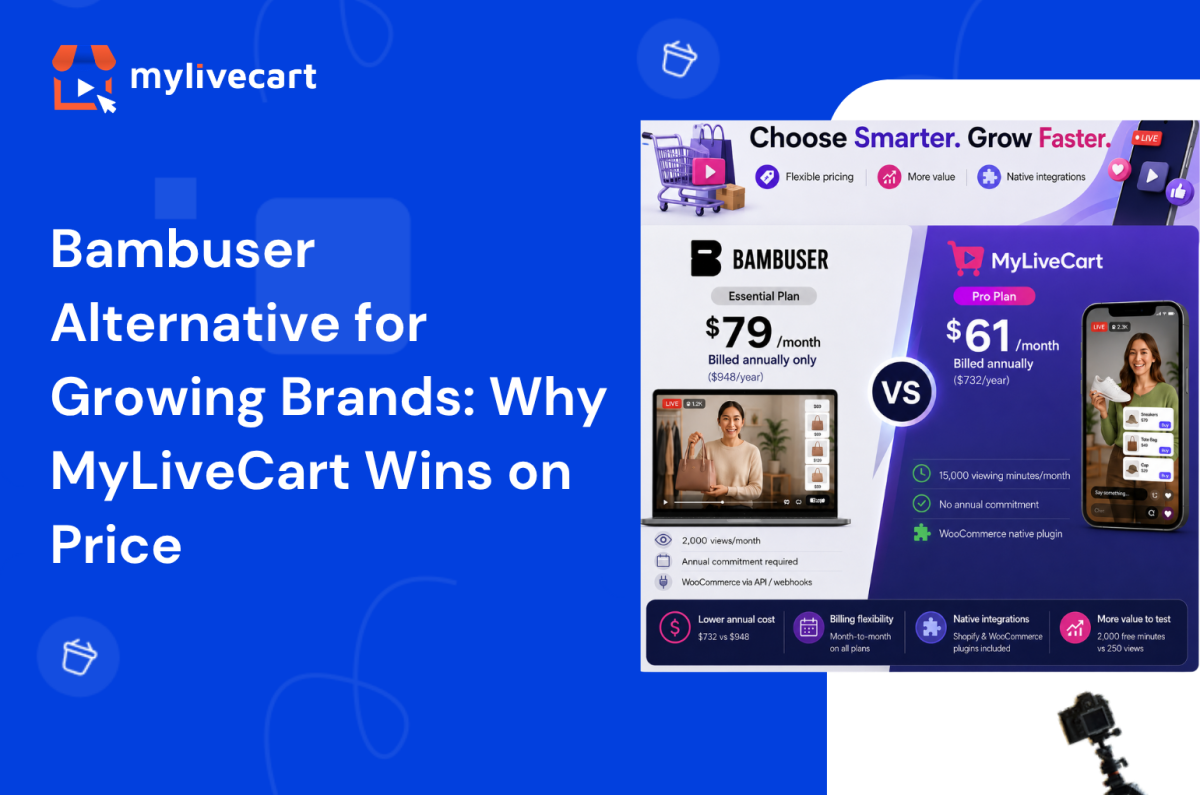
Quick Answer: The strongest Bambuser alternative for growing brands is MyLiveCart. At the same $79/month entry price, MyLiveCart Pro is month-to-month no annual billing required. MyLiveCart’s annual plan is cheaper ($61/month vs Bambuser’s $79/month annual-only Essential tier), and the free plan includes 2,000 viewing minutes per month against Bambuser’s 250 views. Both platforms support Shopify. For WooCommerce, MyLiveCart offers a native plugin; Bambuser relies on custom API integration.

What Is Bambuser?

Bambuser is a Swedish live video commerce platform founded in 2007. It offers two core products: One-to-Many (live shopping broadcast to an audience) and One-to-One (private video shopping with a sales associate).

Originally built for enterprise retailers, Bambuser has expanded its offering to include three published self-serve tiers alongside its Enterprise plan. It powers live shopping for some of the world’s largest retail brands and offers white-label customisation, advanced analytics, and professional services.

Bambuser’s current plans:

  • Free — $0, 250 views/month, 2 users, AI chat support
  • Essential — $79/month, billed annually ($948/year), 2,000 views/month, 3 users, guided onboarding
  • Pro — $249/month, billed annually ($2,988/year), 10+ users, white-labeled player, Mobile SDK, SSO
  • Enterprise — Custom pricing, custom usage, dedicated customer manager

One important detail across the paid tiers: Bambuser Essential and Pro are available on annual billing only. There is no published monthly billing option for either plan.

Why Growing Brands Look for a Bambuser Alternative

The brands most likely to find Bambuser’s model a poor fit are typically at a specific growth stage:

  • Annual revenue: $500K–$20M
  • Team size: 5–50 people
  • Ecommerce platform: Shopify or WooCommerce
  • Live commerce maturity: Testing the channel, running first events, validating product-format fit
Try MyLiveCart Free — No Annual Commitment, No Contract →

At this stage, live shopping software for small and mid-sized businesses needs to be flexible. Committing to an annual plan before you have conversion data from your first event is a real risk. If the channel underperforms or if your strategy changes you are locked in for the year.

You also likely need native WooCommerce support without custom developer work.

MyLiveCart vs Bambuser: Feature Comparison

Feature Bambuser MyLiveCart
Free plan Yes — 250 views/month Yes — 2,000 viewing minutes/month
Entry paid plan $79/month Essential (annual billing only) $79/month Pro (month-to-month)
Annual plan price $79/month (only billing option for Essential) $61/month when billed annually
Annual spend at entry paid $948/year (Essential) $732/year (Pro annual) · $948/year (Pro monthly)
Billing flexibility Annual commitment required on paid plans Month-to-month available on all plans
Self-serve signup Yes — available via app store Yes — direct signup
Shopify integration Yes — Shopify App Store Yes — native plugin, all plans incl. free
WooCommerce integration Via custom webhooks / API Yes — native plugin, all plans incl. free
In-stream checkout Yes Yes
Product tagging during live Yes Yes
Live chat Yes Yes
Event analytics Yes Yes — event + product-level
Event replay / VOD Yes Yes (Pro plan and above)
One-to-one video shopping Yes Roadmap
White-label / custom branding Pro plan only Business plan ($259/month)
Co-host support Yes Yes
Overage rate $0.25 per view $12–15 per 1,000 viewing minutes
Cancel anytime Limited by annual billing Yes — month-to-month plans available
Developer required For WooCommerce integration No — no-code plugin for Shopify + WooCommerce

Looking for a Bambuser alternative for Shopify specifically? Both platforms support Shopify. The key differences are billing flexibility and the WooCommerce question see the full feature breakdown for a detailed comparison.

MyLiveCart vs Bambuser: Pricing Comparison

Both platforms now publish their pricing. Here is how they compare at each tier.

Free Plans

Bambuser Free MyLiveCart Starter
Price $0 $0
Viewing capacity 250 views/month 2,000 viewing minutes/month
Live events Included Unlimited
Shopify integration Yes Yes
WooCommerce integration Via API Yes — native plugin
Streaming duration Not specified Up to 1 hour
Branding Not specified MyLiveCart watermark

Note on metrics: Bambuser counts “views” (unique viewers) while MyLiveCart counts “viewing minutes” (viewers × duration). These are different measurements and not directly comparable. For a 30-minute live event, 250 Bambuser views = 250 unique viewers; 2,000 MyLiveCart viewing minutes = approximately 65–70 viewers at average session length. For shorter shoppable video content, Bambuser’s free plan may support more interactions per month.

Entry Paid Plans

Bambuser Essential MyLiveCart Pro
Price $79/month $79/month (or $61/month annually)
Billing Annual only ($948/year) Month-to-month or annual
Annual spend $948 $732 (annual) · $948 (monthly)
Viewing capacity 2,000 views/month 15,000 viewing minutes/month
Users 3 Unlimited
Event replay Included Yes
Simulcasting Not specified Yes
WooCommerce Via API Native plugin
Overage $0.25/view $12/1,000 minutes

At the same $79/month price point, Bambuser Essential requires a $948 annual commitment upfront. MyLiveCart Pro is available month-to-month — you pay $79 in month one and can cancel before month two if results do not support continuing.

If you are willing to commit annually, MyLiveCart Pro at $61/month saves $216/year compared to Bambuser Essential at $79/month (annual billing).

See the complete MyLiveCart pricing page for current plan details and active offers.

Start on the free plan. Upgrade month-to-month when you’re ready. No year-long commitment.

Start Your Free MyLiveCart Account →

Where MyLiveCart Works Better for Growing Brands

1. No Annual Commitment Required

Bambuser’s Essential and Pro plans are available on annual billing only. You pay for the full year before running a single paid event.

MyLiveCart Pro is available month-to-month. If your first three events do not generate the ROI to justify the subscription, you cancel before the next billing cycle. There is no contract, no minimum term, and no cancellation fee.

2. Cheaper Annual Plan

If you do want to commit annually, MyLiveCart Pro at $61/month ($732/year) is less expensive than Bambuser Essential at $79/month ($948/year) while offering 15,000 viewing minutes per month against Bambuser’s 2,000 views per month (noting these are different metrics).

3. Native WooCommerce Integration

MyLiveCart has a native WooCommerce plugin available on all plans including free. It connects your product catalog, embeds the live stream widget, and routes in-stream purchases through your existing WooCommerce checkout no developer needed.

Bambuser supports WooCommerce via custom API and webhooks. This works, but it requires developer involvement to implement and maintain. For teams without in-house technical resource, this is a meaningful barrier. See the WooCommerce integration guide for how MyLiveCart’s setup works.

4. More Generous Free Plan for Testing

MyLiveCart’s free Starter plan gives you 2,000 viewing minutes per month with unlimited live events, product tagging, in-stream checkout, and live chat enough to run multiple events and build initial performance data before spending anything.

Bambuser’s free plan provides 250 views per month with access to the product suite, which is suited for very limited-scale testing.

5. Shopify Integration Included at Every Tier

MyLiveCart’s native Shopify plugin is included on every plan including free. Connect your product catalog in under 10 minutes. No developer required, no code changes to your store.

Bambuser also has a Shopify app available for all tiers. This is a comparable advantage for both platforms.

At a Glance: Which Platform Is Right for You?

Choose Bambuser if you are comfortable committing to annual billing, your primary store is Shopify (not WooCommerce), you need one-to-one video shopping capability, or you are moving toward the Pro/Enterprise tier for white-label deployment.

Choose MyLiveCart if you want month-to-month billing flexibility, you run a WooCommerce store and need a native plugin, you want the lower annual plan price, or you are still in the early stages of building your live commerce channel.

When Bambuser Might Still Be the Right Choice

Bambuser is the better fit in specific circumstances:

  • You are comfortable with annual billing and your live commerce strategy is confirmed — the Essential plan at $948/year is a reasonable investment for an active programme
  • One-to-one video shopping is a core channel requirement — personalised video consultations at scale, integrated into CRM and service workflows (MyLiveCart has this on roadmap)
  • You need white-label deployment — Bambuser’s Pro plan includes a fully white-labeled player; MyLiveCart offers custom branding on the Business plan
  • Your store is on Shopify — both platforms offer strong Shopify support, so this is less of a differentiator
  • You are scaling toward enterprise — Bambuser’s Pro and Enterprise tiers offer Mobile SDK, SSO, and dedicated customer management for larger operations.

Frequently Asked Questions About Bambuser Alternatives

What is the best Bambuser alternative for small and mid-sized brands?

MyLiveCart is a strong Bambuser alternative for growing brands that want professional live shopping features without an annual billing commitment. It offers a free plan, native Shopify and WooCommerce integration, in-stream checkout, product tagging, live chat, and event analytics with month-to-month billing available on all paid plans.

Is MyLiveCart cheaper than Bambuser?

It depends on how you compare. At the $79/month entry paid tier, Bambuser Essential requires annual billing ($948/year) while MyLiveCart Pro is available month-to-month at $79 or annually at $61/month ($732/year). On annual plans, MyLiveCart is $216/year cheaper. Month-to-month, the entry price is the same — but only MyLiveCart offers that flexibility without a year-long commitment.

Does MyLiveCart integrate with Shopify like Bambuser does?

Yes. MyLiveCart has a native Shopify plugin on all plans including free. It connects your product catalog automatically, embeds the live stream on your storefront, and routes purchases through your existing Shopify checkout. No developer or code changes required. Bambuser also has a Shopify app both platforms support Shopify well.

Does MyLiveCart support WooCommerce?

Yes with a native plugin on all plans including free. This is one of the clearest differences between the two platforms. Bambuser supports WooCommerce via custom webhooks and API, which typically requires developer involvement. MyLiveCart’s WooCommerce plugin connects your store without any custom development.

Can I switch from Bambuser to MyLiveCart?

Yes. If you are currently on a Bambuser plan and your annual term is ending, MyLiveCart is a direct alternative for the core live shopping feature set. Your Shopify or WooCommerce store connects in minutes. Because MyLiveCart offers month-to-month billing, you can also run a parallel event on MyLiveCart to compare performance before fully committing to a switch.

Does MyLiveCart require an annual contract?

No. MyLiveCart plans are available month-to-month. You can upgrade, downgrade, or cancel at any time no minimum term, no cancellation fees. An annual plan is available at a discounted rate if you choose to commit.

What features do both MyLiveCart and Bambuser share?

Both platforms offer: live video broadcast, in-stream product tagging, buy buttons for in-stream purchase, live chat, event analytics, event replay, co-host support, and Shopify integration. The core live shopping feature set is comparable. The primary differences are billing structure (annual-only vs month-to-month available), WooCommerce integration approach, and pricing on annual plans.

Switch to an Affordable Live Commerce Platform That Grows With You

Bambuser is a capable platform and, with published self-serve pricing, now accessible to brands beyond the enterprise tier. The question is not whether Bambuser works it is whether annual billing, API-dependent WooCommerce integration, and the higher annual cost are the right trade-offs for where your business is today.

If you want to start free, validate the channel without a year-long commitment, and run on your WooCommerce or Shopify store with no developer required MyLiveCart is worth serious consideration.

  1. Create your free MyLiveCart account
  2. Connect your Shopify or WooCommerce store in minutes
  3. Run your first live shopping event — at no cost, no annual commitment

Want to see the platform before signing up? Book a free live demo and we will walk through the features, the integrations, and the right plan for your business.
Get a Free Live Demo →
Categories
E-commerce Live Shopping

Live Streaming for Ecommerce: The Complete Guide for Online Stores in 2026

Live streaming for ecommerce is no longer a trend brands are watching from the sidelines. It is the fastest-growing sales channel in online retail and in 2026, every major ecommerce category from fashion to food to consumer electronics is running live shopping events directly on their stores.

The reason is simple: live video converts at rates static product pages cannot match. A shopper who watches a host demonstrate a product, ask questions in real time, and see other viewers buying alongside them is a fundamentally different kind of buyer than one scrolling a product grid alone.

This guide covers everything you need to know how live streaming ecommerce works, what formats drive the most sales, how to choose the right platform, and how to go live on your store today.

Quick Answer: Live streaming for ecommerce is the practice of broadcasting real-time video on your online store while selling products in-stream viewers watch, ask questions, and add to cart without leaving the stream. Brands running live commerce events report 30–45% increases in sales, 60% improvements in customer retention, and conversion rates 3–9x higher than standard product pages. To get started, you need a live streaming platform like MyLiveCart that integrates with your store (Shopify or WooCommerce) and handles the video, chat, and checkout layers for you.

What Is Live Streaming for Ecommerce?

Live streaming for ecommerce also called live commerce, live selling, or livestream shopping is the practice of broadcasting real-time video on your online store while selling products directly through that broadcast. Hosts demonstrate products, answer viewer questions live, and trigger buy buttons on-screen that let viewers add to cart and complete checkout without pausing the video or navigating away.

Unlike traditional video commerce (pre-recorded product videos on a product page), live streaming ecommerce is interactive. The host responds to the audience in real time. Viewers see other people buying. Limited-time offers create genuine urgency. The result is a purchasing environment that more closely resembles a physical retail experience than anything else available in online commerce.

Live commerce originated in China, where it now accounts for over 20% of all ecommerce transactions. Western markets have followed rapidly: live shopping platforms saw triple-digit growth between 2022 and 2025, and the global live commerce market is projected to exceed $500 billion by 2027.

How Live Streaming Ecommerce Works

A live streaming ecommerce event has three layers working simultaneously:

1. The video layer Your host streams live video from a camera smartphone, laptop webcam, or professional setup. The stream is encoded and delivered to viewers via a CDN (Content Delivery Network) with under 5 seconds of latency, so the experience feels genuinely live rather than delayed.

2. The commerce layer Products from your store catalog are loaded into the event in advance. During the stream, the host highlights individual products triggering a product card and buy button to appear on screen. Viewers click “Add to Cart” without leaving the video. Checkout uses your store’s existing payment flow.

3. The interaction layer A live chat panel runs alongside the video. Viewers ask questions, the host responds by name, and other viewers see the exchange. Emoji reactions, viewer counts, and time-limited offer banners create social proof and urgency in real time.

On the backend, every viewer action watch time, product clicks, add-to-cart events, purchases is tracked at the event level, giving you conversion data per product highlighted, not just per page view.

Why Live Streaming for Ecommerce Drives Higher Sales

The performance gap between live streaming ecommerce and static product pages is not marginal it is structural. Live video removes the three biggest objections in online shopping: uncertainty about the product, inability to ask questions, and lack of urgency.

Brands using MyLiveCart’s live shopping platform have reported:

  • 45% increase in sales within the first month of going live
  • 98 products sold in 23 days from a single jewellery brand’s live campaign
  • 3x increase in product inquiries and purchase intent
  • 60% improvement in customer retention
  • 2x improvement in engagement rate compared to static product pages

These results hold across categories fashion, jewellery, skincare, consumer electronics, food and beverage because the underlying mechanism (real-time demonstration + immediate purchase) is category-agnostic.

The conversion advantage comes from four specific dynamics:

Trust built through demonstration: Viewers see the product in motion how fabric falls, how a serum absorbs, how a gadget fits in a hand. This removes the ambiguity that causes hesitation on a product page.

Real-time objection handling: When a viewer asks “does this come in XL?” and gets an immediate answer, that objection is resolved in seconds rather than left to fester until the shopper abandons the cart.

Social proof at scale: Visible viewer counts, live chat activity, and emoji reactions signal that other real people are watching and buying which reduces the perceived risk of purchase.

Scarcity and urgency: “Only 8 left in stock” or “free shipping for the next 10 orders” means something when said live, in real time, rather than displayed as a static label that shoppers have learned to ignore.

Types of Live Streaming Formats for Ecommerce

Not every live stream follows the same format. The right format depends on your product category, audience size, and sales goal.

Product Launch Streams

Reveal a new product live, with an exclusive first-look for viewers. Works especially well for limited editions, seasonal collections, and subscription drops. Creates urgency because the first-mover advantage is real viewers who buy during the launch get it before anyone else.

See How MyLiveCart Powers Live Streaming Ecommerce — Get a Free Demo →

Tutorial and How-To Demos

Show the product being used step by step. Highly effective for skincare, cooking, tools, and anything that requires instruction. The demonstration closes the “but will it work for me?” objection that stops purchases on static pages.

Q&A and Expert Sessions

Host a live interview or panel where a product expert a dermatologist, a chef, a stylist demonstrates and answers audience questions in real time. Builds brand authority while educating viewers about the product.

Flash Sales and Limited-Time Drops

Time-limited offers available exclusively during the live event. Viewer gets a benefit (early access, discount, free shipping) that expires when the stream ends. Creates genuine urgency that static sale banners cannot replicate.

Behind-the-Scenes and Factory Tours

Show how the product is made, where it comes from, or how your brand operates. Particularly effective for brands where provenance and craft matter artisan goods, sustainable fashion, specialty food.

Influencer and Brand Ambassador Collabs

Invite an influencer or ambassador as a co-host. They bring their audience to your stream; you provide the product and purchase infrastructure. Extends your reach without requiring a large existing audience of your own.

How to Choose a Live Streaming Platform for Your Ecommerce Store

The live streaming platform you choose determines what your viewers can do and what data you can act on. Evaluate platforms on these five criteria before committing:

1. Integration with Your Ecommerce Platform

Your live streaming platform must connect directly to your product catalog Shopify, WooCommerce, or a custom backend. Without this, you are manually entering product details before every event, and inventory does not update in real time. MyLiveCart’s full feature set includes native integration for both major platforms.

2. In-Stream Checkout (Checkout Without Leaving the Video)

If a viewer has to navigate to a separate product page to buy, you lose a significant portion of them in transit. The buy button must surface within the stream player and add directly to your store’s cart. This is the most commonly missed requirement in platform evaluation.

3. Event-Level Analytics

You need to know which products converted, not just how many people watched. Platform-level analytics (“1,200 viewers”) are useless for product strategy. Event-level analytics (product A: 47 add-to-carts, product B: 12 add-to-carts, average watch time 14 minutes) tell you how to structure your next event.

4. Replay and VOD

Your live event continues working after it ends if it is available as a replay on your store. Every viewer who missed the live event is a potential buyer of the on-demand version. Platforms that do not record automatically leave that revenue on the table.

5. Pricing That Scales With You

Look for a platform that has a free or low-cost entry point so you can test and learn before committing significant budget. MyLiveCart’s free Starter plan includes unlimited events and 2,000 viewing minutes per month enough to run your first several events and validate the format for your audience before upgrading.

How to Get Started with Live Streaming for Your Ecommerce Store

Getting your first live shopping event live takes less than a day most of it is planning, not setup. Here is the process from zero to live:

Step 1 — Choose Your Platform and Sign Up

Create a free MyLiveCart account at web.mylivecart.com/sign-up. The free Starter plan includes unlimited events, unlimited products per event, and the integration plugin for your store. No credit card required.

Step 2 — Connect Your Store

From your MyLiveCart dashboard, go to Integrations and connect your store. The Shopify integration takes under 60 seconds authorize the app, and your entire product catalog syncs automatically. WooCommerce follows the same process.

Step 3 — Plan Your Event Format and Product Selection

Decide which format fits your goal (launch, demo, flash sale). Select 8–15 products to feature enough to fill a 30–60 minute stream without rushing. Order your products: open with your strongest sellers to build early momentum, then introduce newer or higher-consideration items mid-stream when trust is established.

Step 4 — Promote the Event in Advance

Share your event link 48–72 hours ahead via email, social media, and your store’s homepage. MyLiveCart generates a pre-event page that viewers can bookmark and share. Brands that promote in advance consistently see 2–3x more viewers than unannounced streams.

Step 5 — Go Live

At event time, click Start Event from your dashboard. Your stream embeds on your store automatically. During the event, click products in your event panel to highlight them the buy button appears on screen for all viewers in real time. Respond to chat questions by name. Add urgency with limited-time offers.

Step 6 — Review Your Analytics

After every event, your analytics dashboard shows peak viewers, watch time, products highlighted, add-to-cart rate, conversion rate per product, and total orders. Use this data to decide which products to lead with next time, which offer types drove the most action, and which time slot brought the largest audience.

Ready to run your first event? Your store can be live this week.

Start Live Streaming Free — No Developer Needed →

Live Streaming Ecommerce Best Practices

Keep Events Between 30 and 60 Minutes

Under 30 minutes does not give late arrivals enough time to engage and buy. Over 60 minutes sees significant audience drop-off after the halfway point. The 30–60 minute window consistently produces the highest engagement-to-conversion ratio.

Start Selling Within the First 5 Minutes

Viewers decide within the first 3–5 minutes whether to stay. Lead with a strong product, a compelling offer, or a bold claim then back it up. Audiences who stay past 5 minutes convert at significantly higher rates than those who leave early.

Feature 8–12 Products Per Hour

Fewer than 8 products leaves too much time on each item and loses momentum. More than 15 per hour rushes viewers and reduces their confidence in each purchase decision. Spending 4–6 minutes per product is the optimal pacing for most categories.

Use Your Chat as a Sales Tool

Every question in chat is a sales signal. When a viewer asks “does this ship internationally?” or “what size should I get?” they are close to buying. Prioritise those questions over generic comments. Resolve objections publicly so every viewer watching benefits.

Go Live Consistently, Not Just Once

The brands that see compounding results from live streaming ecommerce go live on a regular schedule weekly or bi-weekly. Audiences learn when to expect you. Returning viewers convert at higher rates than first-time viewers because trust is already established.

Live Streaming on Your Own Store vs. Social Platforms

The most common question from brands starting live commerce is whether to stream on Instagram, TikTok, or YouTube — or on their own store. The answer depends on where you are in your brand journey.

Factor Instagram / TikTok / YouTube Live Live Streaming on Your Store
Audience reach Large, built-in audience Your existing audience + promotion
Checkout location Third-party platform Your own store
Customer data Platform owns it You own it
Product catalog sync Limited or manual Full, automatic
Analytics Views and likes Product-level conversion data
Replay on your store No Yes
Brand control Platform-branded UI Fully your brand

The strategic answer: social platforms are useful for discovery and audience building. Your own store is where sales and data ownership live. The highest-performing brands use both they promote on social, then send viewers to their store for the actual purchase event.

Frequently Asked Questions About Live Streaming for Ecommerce

What is live streaming for ecommerce?

Live streaming for ecommerce is the practice of broadcasting real-time video on an online store while selling products through the stream. Viewers watch a host demonstrate products, ask questions in a live chat, and add items to cart without leaving the video all on the retailer’s own website.

How does live streaming increase ecommerce sales?

Live streaming increases ecommerce sales by removing the three main objections that stop online shoppers: uncertainty about the product (resolved by live demonstration), inability to ask questions (resolved by real-time chat), and lack of urgency (created by limited-time in-stream offers and visible social proof).

What equipment do I need to start live streaming for ecommerce?

You need a device with a camera (smartphone or laptop works), a stable internet connection, and a live streaming platform connected to your store. No professional studio equipment is required to start brands run successful live events from phones and basic ring lights.

Which ecommerce platforms support live streaming?

Shopify and WooCommerce both support live streaming through MyLiveCart’s native plugins. The live stream embeds directly on your store across all platforms.

How long should a live shopping event be?

Most successful live shopping events run between 30 and 60 minutes. This is long enough for late joiners to engage and buy, but short enough to maintain audience attention and host energy throughout. Events under 20 minutes tend to underperform because they do not allow time for the audience to warm up and trust the host.

How many products should I feature in a live event?

Most successful live shopping events feature 8–12 products in a 30–60 minute stream roughly one product every 4–6 minutes. This pacing gives viewers enough time to consider and buy each item without feeling rushed, while maintaining momentum across the event.

Is live streaming ecommerce only for large brands?

No. Live streaming ecommerce works across brand sizes. The advantages real-time demonstration, live Q&A, urgency apply equally to a small jewellery maker with 500 email subscribers and a large fashion retailer with millions of followers. MyLiveCart’s free plan is specifically designed for brands starting their first live commerce events.

Start Live Streaming for Your Ecommerce Store Today

Live streaming ecommerce is not a future consideration it is the channel your competitors are already testing. The brands that establish a consistent live shopping presence now will have a significant advantage in audience trust, conversion data, and repeat buyer rates by the end of 2026.

Getting started takes three minutes:

  1. Create your free MyLiveCart account
  2. Connect your Shopify or WooCommerce store
  3. Run your first live event this week

If you would like a specialist to walk through your first event setup, book a free live demo and we will plan your first stream together format, product selection, promotion, and analytics review included.

Start Your First Live Shopping Event Today